Friday, May 06, 2005

The Council Has Spoken !

Image hosted by Photobucket.com
This week's winners in the Watcher's Council are now posted at the Watcher's site. Every week the Council nominates posts from the blogs of the Council members, and posts from around the blogsphere. The Council then votes to select the "Best" of all these posts.

BEST COUNCIL POSTS:

First Place:
Hostages: Time for America to Act Carpe Bonum

Second Place: A THREE-WAY TIE !

U.S. Policy of Total Extermination in Iraq? The Glittering Eye

Where Angels Fear to Tread Gates of Vienna

The Paranoid Style Dr. Sanity

BEST NON-COUNCIL POSTS:

First Place:
The Great Islamic Warrior: Stewardresses, Elementary Schoolchildren and Wounded Crash Survivors New Sisyphus

Second Place:
Wilsonians, Part I Done With Mirrors

All the winners are great reading from the blogsphere! Check them out at Watcher of Weasels !

Of Course We Don't Know

From FrontpageMagazine.com :

Did you know that 47 countries have re-established their embassies in
Iraq?

Did you know that the Iraqi government employs 1.2 million Iraqi people?

Did you know that 3100 schools have been renovated, 364 schools are under
rehabilitation, 263 schools are now under construction and 38 new schools have been built in Iraq?

Did you know that Iraq's higher educational structure consists of 20 Universities, 46 Institutes or colleges and 4 research centers?

Did you know that 25 Iraq students departed for the United States in January 2004 for the re-established Fulbright program?

Did you know that the Iraqi Navy is operational? They have 5 100-foot patrol craft, 34 smaller vessels and a naval infantry regiment.

Did you know that Iraq's Air Force consists of three operation squadrons, 9 reconnaissance and 3 US C-130 transport aircraft which operate day and night, and will soon add 16 UH-1 helicopters and 4 bell jet rangers?

Did you know that Iraq has a counter-terrorist unit and a Commando Battalion?

Did you know that the Iraqi Police Service has over 55,000 fully trained and equipped police officers?

Did you know that there are 5 Police Academies in Iraq that produce over 3500 new officers each 8 weeks?

Did you know there are more than 1100 building projects going on in Iraq?
They include 364 schools, 67 public clinics, 15 hospitals, 83 railroad stations, 22 oil facilities, 93 water facilities and 69 electrical facilities.

Did you know that 96% of Iraqi children under the age of 5 have received the first 2 series of polio vaccinations?

Did you know that 4.3 million Iraqi children were enrolled in primary school by mid October?

Did you know that there are 1,192,000 cell phone subscribers in Iraq and phone use has gone up 158%?

Did you know that Iraq has an independent media that consist of 75 radio stations, 180 newspapers and 10 television stations?

Did you know that the Baghdad Stock Exchange opened in June of 2004?

Did you know that 2 candidates in the Iraqi presidential election had a recent televised debate recently?

OF COURSE WE DIDN'T KNOW! WHY DIDN'T WE KNOW?

OUR MEDIA WOULDN'T TELL US!


I didn't know. Did you?

Goodbye Kofi Annan

More bad news for Kofi:

U.N. investigators have turned over to Congress boxes of evidence on the Oil-for-Food program, including "proof" that U.N. Secretary-General Kofi Annan lied to the Independent Inquiry Committee probing the scandal, Fox News Channel reporter Jonathan Hunt said Thursday.

"One source close to the case told me that in those boxes is the ammunition to prove that Kofi Annan lied to investigators," Hunt told Fox News Radio host Tony Snow. "So this is a very dramatic development indeed."


My feelings on the matter can be best summed up by Ace:

Pleasepleasepleasepleasepleaseplease...

Just a few short weeks ago, Glenn Reynolds quoted a Montreal Newspaper:

In an editorial headlined: "Report Spells the End of Kofi Annan," the Montreal Gazette noted that Annan's then executive assistant destroyed three years worth of files on Oil for Food the day after the Security Council passed a resolution authorizing Volcker's inquiry.

"Just connect the dots," the newspaper said. "What a damning picture it is. Its reputation already in tatters, the U.N. stands today weaker than it ever was. Only major governance reforms can save the world body now, and the first order of reform business needs to be finding a credible replacement for Annan."


Someday....Meanwhile here's a little ditty to speed him off; sung to the tune of "Goodbye Yellow Brick Road", by Elton John.

Goodbye Kofi Annan

When are you gonna step down?
When are you gonna be gone?
You should have left long ago
Instead of just hangin' around

You know you can’t hold on forever
The world is on to you
You're not some guy who is indispensable
It's way past time to get somebody new

So goodbye Kofi Annan
Goodbye to Kojo, farewell
When you were secretary general
The UN went straight to hell

Your leadership was a disaster
Cotecna, Sex and Saddam
And now if they've got a future
It's beyond dear Kofi Annan

What do you think you'll do then
Without a scandal or two
A dictator somewhere will take you in
Just remind them how much they owe you

Someday there'll be a replacement
Although you say you won't go
You don't talk much about Darfur
But on leaving you shout a "hell no"

So goodbye Kofi Annan
Goodbye Kojo, farewell
And remember when you were in charge
The UN descended to hell

Thursday, May 05, 2005

The Sad Problem of Terrorist Morale

Have you heard? Terrorist morale is at an all time low in Iraq. How sad.... And, if we aren't careful, soon their self-esteem will impacted; and then just think of all that psychological pain. Oh, the horror!

I feel for them. I really do.

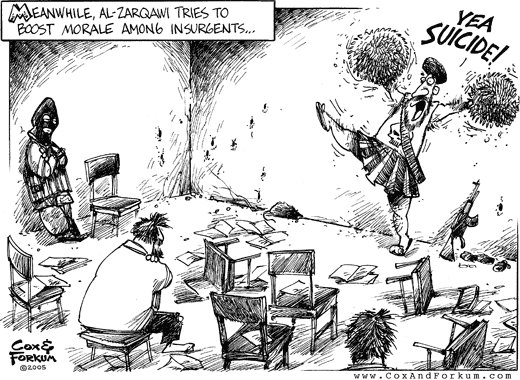
Meanwhile, Zarqawi is trying to figure out ways to improve morale and give his minions something positive to focus on....


Of course, his idea of "positive" and theirs might be a little different. Cox and Forkum really capture the essense of this dilemma! Posted by Hello

The Terrible Ifs Accumulate

The terrible Ifs accumulate - Winston Churchill

Reading a recent Wretchard post where he links to an earlier post of his, I was reminded that I was much impressed with that earlier post from 2003. Since I wasn't blogging back then, I thought I'd link to it now, since its relevance has only increased. .

In that brilliant post from September, 2003 "The Three Conjectures", Wretchard initiates a line of impeccable logic to conclude:

It is supremely ironic that the survival of the Islamic world should hinge on an American victory in the War on Terror, the last chance to prevent that terrible day in which all the decisions will have already been made for us.


If you have not read this analysis, I strongly urge you to do so. It will forever change your view of the War on Terror (as it did mine when I first read it).

What has troubled me then, as it still does now, is the nagging feeling I have of the inevitability of the worse possible outcome in this all-to-possible scenario. We a dealing with human beings--no, worse--we are dealing with completely and totally irrational human beings.

Mohammad the Prophet set off a chain of events 1400 years ago that have brought us to where we are today. Islam's virulence has mutated for the worse over the centuries, destroying the once vibrant civilization in the Middle East. Now, wholly embracing the most primitive and emotion-driven ideology, the true believers of Islam find themselves in possession of technology and weapons that they never could have imagined in their wildest dreams. As with any despotic mindset, they see this technology not as a way of liberating people; but the key to enslaving them to their sick vision.

Dr. Sanity is a "Bad LSD Trip"

Image hosted by Photobucket.com I'm truly honored. Apparently, my blog gives some people on the left "ice cream headaches" that they compare to a bad LSD trip!

Over at the Air America Randi Rhodes Show [you know, the Air America talk show hostess who recently had a skit on her radio show where someone shot President Bush, causing the Secret Service to investigate threats to the President? Yeah, that Randi Rhodes] Message Board, the following was posted:

When I want an ice cream headache I go to http://drsanity.blogspot.com/ ....but haven't had the need for a long time...it's amazing what they think and believe...it's like a bad LSD trip!

Isn't that nice? It reminded me of the drug awareness campaign:

THIS IS YOUR BRAIN:
Image hosted by Photobucket.com


THIS IS YOUR BRAIN ON DR. SANITY:
Image hosted by Photobucket.com

It looks good to me!

Wednesday, May 04, 2005

The Magic Bullet

Back in February, Shrinkette posted a sad email from a friend , which I saw when going through her archives:

Liz Ditz, of I Speak Of Dreams, sends e-mail:
My goodness. Today seems to be "let's talk about depression day." I had lunch with a friend today. Two weeks ago a mutual friend committed suicide. This friend was a year older than I am (55) and was very much part of a net of love and respect. He was a good father and husband, a leader in his men's prayer group, and part of warm and loving family. His wife's brother had recovered from a hellacious alcohol and cocaine problem, 15 or 20 years ago, so the family circle was no stranger to pain and struggle and redemption. Despite this love and affection, the friend dove under a train in motion. The big question at lunch was "Why"? Why would you so hurt your family and friends? Why did he walk and walk down the railroad right-of-way that runs through this sleek, privileged Silicon Valley town, just to leap from leafy hiding into the noise and metal?

Into the noise, and metal, and annihilation. We're left to guess why. For clues, I turn back to my previous post, "I was just going to take all my medications."

Liz goes on:
In talking with non-psychiatrist physicians, I find a touching faith in the magic-bullet nature of medication.
(I love that sentence!)


The post continues, and I recommend that you check it out. But the thing that caught my attention (besides the sad death of a friend) was the phrase "magic bullet nature of medication."

Notice also the phrase "non-psychiatrist physician" are the ones with a "touching faith" in the power of medications.

In the medical profession, we often refer to "magic bullets", which are what we call those treatments that miraculously "cure" a condition. There is, of course, a certain irony in this description, since there are few medications in any medical specialty that truly produce a cure (although there are some); and none that do it without side effects --some of them quite severe; and some of them that are worse than the disease itself.

Psychiatrists tend to be more humble about this reality than most physicians. And they should be.

None of the drugs that "cure" can be found in the psychiatric formulary. We have some good medications--even some very good medications-- but none are free of side effects and/or complications; and most are not that much better than placebo.

What that means is that all of the medications we use--for depression, for psychosis, or mania, for anxiety--all statistically make most people feel better, but only a little bit better than a sugar pill that people think is a drug for their disorder. In fact, the so-called "placebo effect" is a powerful component of how all medications work.

The placebo effect

is the measurable, observable, or felt improvement in health not attributable to treatment. This effect is believed by many people to be due to the placebo itself in some mysterious way. A placebo (Latin for “I shall please”) is a medication or treatment believed by the administrator of the treatment to be inert or innocuous. Placebos may be sugar pills or starch pills. Even “fake” surgery and “fake” psychotherapy are considered placebos.

Researchers and medical doctors sometimes give placebos to patients. Anecdotal evidence for the placebo effect is garnered in this way. Those who believe there is scientific evidence for the placebo effect point to clinical studies, many of which use a control group treated with a placebo. Why an inert substance, or a fake surgery or therapy, would be effective is not known.


Below is a rather typical result from a study that looked at a particular psychiatric medication (in this case it was for Mania) compared to a placebo. The medication is a real drug (although I haven't identified it specifically) and the graph represents the results of a real study. Improvement in manic symptoms over time was measured by a rating scale (the Young Mania Rating Scale- YMRS)and the results show a decrease in the YMRS score, meaning fewer manic symptoms; or less severe symptoms.
Image hosted by Photobucket.com
As you can see from the graph above, the placebo has an effect all its own over the entire course of the study; and strangely enough, the medication is not that much better than that placebo effect. But it is somewhat better, and that's why this particular medication was approved by the FDA to treat Manic symptoms.

My point is, this is a "magic bullet"?? Not really--by my definition of "magic". If anything, it is the placebo that is magic. It supposedly, does nothing in reality, yet it does!

Many people believe that the placebo effect is a purely psychological phenomenon, and that it occurs because people believe they will get better on medication. Some researchers believe that most psychiatric medications (and a lot of non-psychiatric medications) work almost exclusively through the placebo effect (here is an example of a meta-analysis of antidepressant studies that concludes that 75% of antidepressant effects can be accounted for by a placebo effect). As the editor in which that study was published noted-- it is a controversial study, using a controversial statistical technique. But at the least, such analyses should make psychiatrist and their patients realize that medication may help, but it is not the be-all and end-all; or even the most fabulous, fantastical, magical, wonderful thing in the whole world.

And to further confound this complicated situation, the doctor's optimism and positive attitude toward the drug can have a profound effect on how well a patient responds to it. So, a doctor who is realistic and tells a patient that they will likely only get a small benefit from the medication, will --as a result of his or her honesty--have a lot of patients who don't get better.

Not very inspiring is it?

Consider this: con artists; medical frauds and fakes; quacks and really really bad doctors can all have fanatically devoted patients who swear by their treatments and insist that--no matter what science says--the medication their doctor gave them worked!

As a scientist, and as a physician, I frequently ponder these things. This is why I have come to believe that, while the biological is extremely important; and grows more important as we obtain more knowledge; the psychological and the social are equally (and often even more) important. I try to never forget this when I am dealing with someone suffering from depression or other emotional disorder.

As Voltaire (1694-1778) the great poet, historian and satirist, once commented, "Doctors prescribe medicine of which they know little, to cure diseases of which they know less, in human beings of which they know nothing." He also wisely noted that, "The art of medicine consists of amusing the patient while nature cures the disease."

If anything, the real "magic bullet" in medicine that fights disease and ameliorates physical and psychological suffering is the dynamic relationship between the patient, the doctor, and nature.

Darkness in the North

This is a must-read column by Christopher Hitchens about North Korea:

In North Korea, every person is property and is owned by a small and mad family with hereditary power. Every minute of every day, as far as regimentation can assure the fact, is spent in absolute subjection and serfdom. The private life has been entirely abolished. One tries to avoid cliché, and I did my best on a visit to this terrifying country in the year 2000, but George Orwell's 1984 was published at about the time that Kim Il Sung set up his system, and it really is as if he got hold of an early copy of the novel and used it as a blueprint. ("Hmmm … good book. Let's see if we can make it work.")

Actually, North Korea is rather worse than Orwell's dystopia. There would be no way, in the capital city of Pyongyang, to wander off and get lost in the slums, let alone to rent an off-the-record love nest in a room over a shop. Everybody in the city has to be at home and in bed by curfew time, when all the lights go off (if they haven't already failed). A recent nighttime photograph of the Korean peninsula from outer space shows something that no "free-world" propaganda could invent: a blaze of electric light all over the southern half, stopping exactly at the demilitarized zone and becoming an area of darkness in the north.

Hitchens tells it like it is--and it is much worse than even Orwell's horrific society.

A Plan To Retake Academia

Thanks to PowerLine for the referral, this article proposes how our universities and colleges can be taken back from the Left. Here is a statement of the problem:

With a few notable exceptions, our most prestigious liberal arts colleges and universities have installed the entire radical menu at the center of their humanities curriculum at both the undergraduate and the graduate levels. Every special interest—women’s studies, black studies, gay studies, and the like —and every modish interpretative gambit—deconstruction, post-structuralism, new historicism, and other postmodernist varieties of what the literary critic Frederick Crews aptly dubbed “Left Eclecticism”—has found a welcome roost in the academy, while the traditional curriculum and modes of intellectual inquiry are excoriated as sexist, racist, or just plain reactionary.


And the solution?

As with any disease, the malady besetting academia requires two stages of therapy: first accurate diagnosis, then effective treatment. In some ways, the diagnostic stage is the most difficult, because it is the hardest to sustain. One corollary of society’s natural obedience to the unenforceable is the tendency to assume that those institutions in which we have invested great trust are inherently trustworthy. “Academic institutions are expensive, socially respected bodies whose imprimatur is a powerful door-opener and tool of accreditation, ergo they must be doing a good job.” Some such sentiment is the prevailing one, so when someone like Ward Churchill comes along to remove the scab, the shock is great—and unwelcome. One of the chief tasks for critics of what has happened to academic life in this country is to show the extent to which Ward Churchill, the Kirkland Project, the transgender follies at Smith College and elsewhere, and similar deformations are not exceptions but the predictable result of institutions that have gradually abandoned their commitment to education for the sake of radical posturing. The prime difficulty facing the aspirant diagnostician is not the elusiveness of symptoms—they are florid and ubiquitous—but the patience required to set forth chapter and verse repeatedly and in language that effectively conveys the depredations on view.

The bright side of the Ward Churchill affair was the fact that public scrutiny brought dramatic, if local, changes. The melancholy side of the affair lay in the fact that the scrutiny had to be enormous and unremitting and that, as the media’s attention wandered so did the public’s interest. If real change is going to come to academic culture, criticism must be ceaseless, pointed, and deep. It is not enough to expose Ward Churchill. The academic culture that breeds and rewards such figures—and their name is legion—must be exposed for what it is: a thoroughly politicized rejection of the principles that inform liberal learning.

In one sense, the diagnosis of the calamity that has befallen academic culture is inseparable from the task of treatment. Which is to say that the job of criticism is never finished. Basic questions, the answers to which one could once have assumed were taken for granted, must be asked anew. To whom is the faculty accountable? To the extent that it holds itself accountable to its pedagogic duties, it is accountable to itself. To the extent that it repudiates those duties, it is accountable to the society in which it functions and from which it enjoys its freedoms, privileges, and perquisites. Faculties often take it amiss when critics appeal over their heads to alumni, trustees, or parents. But ultimately teachers still stand in loco parentis, if not on everyday moral issues then at least with respect to the content of the education they provide. Many parents are alarmed, rightly so, at the spectacle of their children going off to college one year and coming back the next having jettisoned every moral, religious, social, and political scruple that they had been brought up to believe. Why should parents fund the moral de-civilization of their children at the hands of tenured antinomians?


This is an extremely interesting and thought-provoking article and I would recommend it to anyone concerned about the abysmal intellectual state of our colleges and universities today. Believe me, those of you who are not connected with academia cannot possibly imagine--even with the recent increased scrutiny because of the Ward Churchill and other university debacles--how inbred and perversely leftist are most of the departments in academe.

This past weekend I was at a dinner where I met several academics--one from English and one from a Social Work department. As is usual in such activites the topic turned to politics and unsurprisingly, the gratuitous comments about "those awful Republicans, don't you know" and "BushHitler" were made.

I've been to too many of these affairs to be surprised at this, but everytime it happens it is simply mind-bogglingly breathtaking to me that my esteemed colleagues could possibly assume that everyone thinks exactly like they do!

The tragedy is that they actually stopped thinking some time ago.

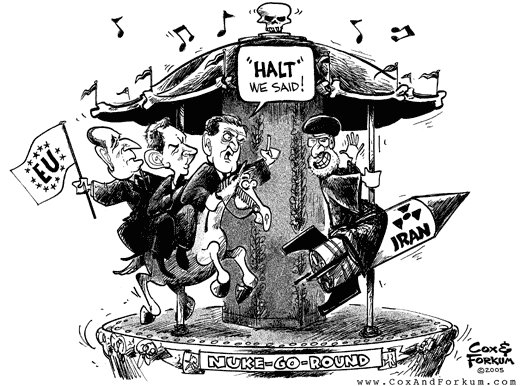
The Circle Game


From Cox and ForkumPosted by Hello

Tuesday, May 03, 2005

Just Do It

Victor Davis Hanson makes a case for consistency in promoting Democracy in the Middle East:

Picking and choosing among authoritarian regimes—heavily pressuring Iran and Syria while going lightly on Egypt and Saudi Arabia—suggests that we seek not a universal democratization of the Middle East but rather compliant governments of any autocratic or monarchic kind that will share and serve American interests, so long as they do not overtly support terror. In a war of ideas, such perceived hypocrisy—a major theme of Osama bin Laden’s infomercials damning U.S. support for the Saudi royal family—can be extremely detrimental.

Nor is inconsistency the only problem. Tens of thousands of American soldiers are fighting in the belief that replacing dictators with democrats is not only smart for America but good for the people of the Middle East. How can we go on asking them to die for freedom in the Sunni Triangle while their government subsidizes dictatorship in Egypt and Pakistan—the former a weak heartbeat away from a populist revolt, the latter a bullet away from theocracy?

The President’s bold plan appears to be based on a model of democratic contagion. We have seen such infectious outbreaks of popular government in Latin America and Eastern Europe, so we know the prognosis is not fanciful. But in the Muslim and Arab Middle East, democracy has no real pedigree and few stalwart proponents. Thus, recalcitrant autocracies will inevitably serve as sanctuaries and strongpoints for those trying to reverse the verdict in an Afghanistan, an Iraq, or a Lebanon; the idea that these same anti-democratic societies are supported by the U.S. is presently embarrassing and eventually unsustainable.


I completely agree with this position. The time has come to stop supporting the tyrants who run these countries and start applying the same bold demands with resultant consequences that we did in Afghanistan and Iraq. Going around holding hands with a Saudi prince does not inspire much confidence that such action is forthcoming, but it is necessary to maintain the dynamic processes already begun in that part of the world.

Come on, Mr. President. Now is not the time to get cold feet. Just Do It.

Scrappleface Newsflash!

"Girl, 13, Gets Abortion, But No TV for a Week".

READ ALL ABOUT IT!

Could This Be The Future of Space Flight?


Could this be the future of space flight? (hat tip: Instapundit) The picture at left is the Lockheed design. Check out the article at PopularMechanics.com.

NASA requested designs for a Crew Exploration Vehicle (CEV), two major teams--one headed by Lockheed Martin and one by Northrop Grumman and Boeing--took on the challenge. The winning concept will be chosen in 2008, and the manned vehicle flown in 2014.

As Glenn notes, the design is reminiscent of the old DynaSoar program initiated in 1957 and cancelled in 1963. Below are some of the designs submitted for that program. The most popular were the Martin-Bell and Boeing designs. The X-20A or, Dyna-Soar (Dynamic Soarer) was asupposed to be a single-pilot manned reusable spaceplane, and was the earliest American manned space project to result in development contracts.

Politics at the time changed the primary purpose of the program many times. First it was supposed to be a manned space bomber; then a high speed test vehicle; and finally, a reconnaissance platform. It was designed to be launched with a succession of launch vehicles, including Titan I, Titan II, and the Titan IIIC. Here is a description of the original purpose of the X-20A:

The klaxon sounds in the hardened silo deep beneath the earth. A space-suited astronauts run from the ready room, grabs the bar over the hatch, and hoists his legs into the cockpit. The ground crew attach his suit hoses, check that he is strapped into the ejection seat. The pilot closes the hatch above him. The blast doors open, the rocket is raised to the surface of the earth. Minutes later the Titan roars from the silo, launching the Dyna-Soar space bomber on an intercontinental nuclear strike mission.


Image hosted by Photobucket.com

Just goes to show that everything old is new again!

Soccer and the War on Terror

Well, here is some good news that is in contrast to how its being played here.

From the former article:

Reports of credible terrorist threats against the United States are at their lowest level since the attacks of Sept. 11, 2001, according to U.S. intelligence officials and federal and state law enforcement authorities.

The intelligence community's daily threat assessment, developed after the terrorist attacks to keep policymakers informed, currently lists, on average, 25 to 50 percent fewer threats against domestic targets than it typically did over the past two years, said one senior counterterrorism official.

A broad cross section of counterterrorism officials believes al Qaeda and like-minded groups, in part frustrated by increased U.S. security measures, are focusing instead on Americans deployed in Iraq, where the groups operate with relative impunity, and on Europe.

Though some are expressing caution and even skepticism, interviews last week with 25 current or recently retired officials also cited progress in counterterrorism operations abroad and a more experienced homeland security apparatus for a general feeling that it is more difficult for terrorists to operate undetected.

And earlier in the week, the same paper (Washington Post) reported the following:

The number of serious international terrorist incidents more than tripled last year, according to U.S. government figures, a sharp upswing in deadly attacks that the State Department has decided not to make public in its annual report on terrorism due to Congress this week.

Overall, the number of what the U.S. government considers "significant" attacks grew to about 655 last year, up from the record of around 175 in 2003, according to congressional aides who were briefed on statistics covering incidents including the bloody school seizure in Russia and violence related to the disputed Indian territory of Kashmir.

Terrorist incidents in Iraq also dramatically increased, from 22 attacks to 198, or nine times the previous year's total -- a sensitive subset of the tally, given the Bush administration's assertion that the situation there had stabilized significantly after the U.S. handover of political authority to an interim Iraqi government last summer.

The State Department announced last week that it was breaking with tradition in withholding the statistics on terrorist attacks from its congressionally mandated annual report. Critics said the move was designed to shield the government from questions about the success of its effort to combat terrorism by eliminating what amounted to the only year-to-year benchmark of progress.


If you watched the President's News Conference, you may have noticed that he was asked about the increase in overseas terrorism:
Q: Mr. President, your State Department has reported that terrorist attacks around the world are at an all-time high. If we're winning the war on terrorism, as you say, how do you explain that more people are dying in terrorist attacks on your watch than ever before?

BUSH: Well, we've made the decision to defeat the terrorists abroad so we don't have to face them here at home. And when you engage the terrorists abroad, it causes activity and action.

And we're relentless-- we, America and our coalition partners. We understand the stakes.

And they're very high, because there are people still out there that would like to do harm to the American people.

But our strategy is stay on the offense, is to keep the pressure on these people, is to cut off their money and to share intelligence and to find them where they hide.

And we are making good progress. The al-Qaida network that attacked the United States has been severely diminished. We are slowly but surely dismantling that organization.

In the long run, like I said earlier, the way to defeat terror, though, is to spread freedom and democracy. It's really the only way in the long term.

In the short term we'll use our troops and assets and agents to find these people and to protect American. But in the long term, we must defeat the hopelessness that allows them to recruit by spreading freedom and democracy.

But we're making progress.

Q: So in the near term you think there will be more attacks and more people dying?

BUSH: I can't predict that.

In the near term I can only tell you one thing: We will stay on the offense. We'll be relentless, we'll be smart about how we go after the terrorists, we'll use our friends and allies to go after the terrorists, we will find them where they hid and bring them to justice.


I was thinking about all of this while I was at my daughter's soccer game the other day. The Boo wants to become a professional soccer player and I am quite proud of her ability in the game. She has followed in my own footsteps and become a goalkeeper. When I was in college I learned to play soccer and became a keeper. Later in Medical School, I played semi-pro women's soccer --which, BTW, is not too shabby when you consider that soccer was not the popular sport it is today in the US; AND that women's sports were practically non-existent at the time (70's).

At any rate, I was reflecting that one of the most basic mistakes that soccer goalkeepers make is staying rooted to the goal and failing to come out to meet the attacker and narrowing the angle of his attack on the goal. It suddenly struck me how applicable this principle was to the War on Terror.

There are many who think that staying vigilant right in the goal is the best way to prevent future terror attacks. But the concept of "narrowing the angle of attack" is relevant to terrorists. By moving out to where they are and not waiting for them to have a clear shot at a goal that--under all circumstances--is impossible to protect 100% of the time, we keep the attacker occupied outside the goal and significantly lessen his chances of achieving a score. If he does try to score anyway, the keeper has increased the chance of his strike going wide and missing its target.

Of course, this doesn't stop the action. The ball continues to get kicked by many other players and passed around. Others can be passed to and they can still make a long kick toward the goal.

But far and away the best method of preventing a score when there is a breakaway, is for the keeper to come out, narrow the angle and meet the offense outside the immediate goal area. Image hosted by Photobucket.com

I should mention though, that it doesn't always work. Sometimes, even when the keeper is one of the best, a goal can be scored. You just can't prevent it. Additionally, coming out of the goal puts the keeper at increased risk of injury because the sliding save is a dangerous maneuver.

A successful defense depends on a lot of factors; but in the long run in soccer--like in so many other things in life--the best defense can be a good offense.

Monday, May 02, 2005

A Free Thinking Italian

Stefania, an Italian blogger at Free Thoughts has something to say about the Sgrena affair:

The Italian gov't has pubblished its version on the Sgrena case. Well, there is nothing that really proves that the U.S. soldiers are to blame. Far from it, it shows that we Italians have something to hide.

For a moment,Italy must stop playing alway the victim.More evidence is showing that the Italian gov't has paid the terrorists,comunicating with them directly.

Worst, it is endangering our alliance with the US for defending a "truth" which does not exist.

The Left praises the gov't' s "version" and says "sometimes this gov't shows that it is not a US puppet"..

I am really disgusted by this overall attitude.


If you haven't checked out her blog yet, go on over there. Stefania is a tireless advocate for Freedom movements all around the world!

UPDATE: Captain Ed is also keeping abreast of this story.

UPDATE 2: Here is the Italian side of the story. The key point:

The investigators found no evidence, however, that the March 4 killing of intelligence agent Nicola Calipari was deliberate. The Italians also didn't object to many of the factual findings contained in a separate American report made public Saturday.


You might want to read the entire article. It seems that the Italians need to "save face" and can't quite be explicit that they agree with the American report for internal political reasons. That's my take, anyway.

Invitation to a Beheading

Over at VDH Private Papers there is a gruesome memoir by an American Ex-pat depicting a slice of life (or, more accurately, a "slice of death") in the Saudi theocracy.

After noon prayer a police van holding the prisoner parked in Chop Chop Square next to the mosque. Police cars blocked off the streets and pushed the growing crowd back. The prisoner—drugged, cuffed, barefoot, manacled, and blindfolded—was led from the van by a police officer to the center of the square and made to kneel down, facing the holiest city of Islam: Mecca.

Like all expatriates in the crowd, Fred was escorted to the front by a scrawny muttawwa to ensure he wouldn't miss a thing. A minor official from the Interior Ministry read out the charges against the kneeling prisoner. The executioner—a large black man with a scimitar—approached the kneeling prisoner from behind. After the sentence was read, the executioner jabbed the prisoner in the lower back with the tip of the sword, causing the prisoner to involuntarily jerk up. When he did, the sword flashed down. At that moment the head is sliced off and sent flying across the square. Blood jets from the severed carotid arteries and jugular veins, spraying into the air like a fountain. The frenzied crowd screams in choreographed unison, "Allah Akbar"!


THE GOOD GOD AND THE EVIL GOD

The Good God and the Evil God met on the mountain top.
The Good God said, "Good day to you, brother."
The Evil God did not answer.
And the Good God said, "You are in a bad humour today."
"Yes," said the Evil God, "for of late I have been often mistaken
for you, called by your name, and treated as if I were you, and it
ill-pleases me."
And the Good God said, "But I too have been mistaken for you and
called by your name."
The Evil God walked away cursing the stupidity of man.
--Kahlil Gibran, The Madman

Villains and Scoundrels

The Boo is literally overcome with excitement and anticipation about the opening of Revenge of the Sith later this month. Here's a glowing review of the movie (hat tip: Ace).

She has been a Darth Vader fan since she was 2 years old and obsessively watched Star Wars hundreds of times on video. I remember thinking, uh-oh--why does she like the villain? "Mommy," she told me, "he's stronger than anybody. I feel safe with him."

Safe? Safe? I couldn't imagine why she needed Darth Vader to make her feel safe (identification with the aggressor? monsters under the bed? bad parenting?)

For her 5th birthday, my husband and I arranged a special surprise visit from a Darth Vader impersonator (very realistic, with light saber and ominous breathing) who arrived in the middle of her birthday party to surprise her. There were about 10 other kids at the party. Unfortunately, it was a total and complete disaster--an event that she will likely mention in any future psychotherapy as being one of the more traumatic ones in her life. Kids started screaming and crying and running away in terror. The adults watched in horror at the sudden conversion of a happy birthday party into a frenzy of frightened and hysterical 5 year olds.

Sobbing, and gasping for breath as I held her shaking little body that day and tried to explain that it was only someone pretending to be the Sith Lord; she told me that she thought that our imitation Darth Vader had been real and that he had come to her party to kill her and all her friends.

"But I thought you liked him!" I wailed (definitely no "mother of the year" award for me).

"Mommy, I like him in my imagination. Not for real."

Wow. Did I learn a lot that day. She reminds me of that horrible birthday rather frequently (I think its a way of putting me in my place when I get too overbearing) and is wont to announce to all and sundry at the most inopportune times of how I permanently traumatized her on her 5th birthday by inviting the Lord of the Sith.

Since that awful party, she has had less interest in Vader (although she really thinks Hayden Christianson is "cute") and has taken up with a somewhat less evil character--Boba Fett, the Bounty Hunter. She knows every line of his dialog (there were only four) and has read every book, comic and fan site that discusses him. While I bought her his trademark helmut for Christmas last year, I most certainly didn't invite him to her 12th birthday party.

I guess Boba Fett is progress of a sort. She despises Luke Skywalker ("he's so goody-goody"), and my best hope is that she'll eventually settle for a Han Solo--who at the least is a dedicated scoundrel.

Scoundrels can be nice.

Smiting Theocracy

Here we are in a war on Islamic fundamentalism, and the Left seems to think that the U.S. is at risk for a Christian theocracy.

During the 2004 Presidential campaign, one of my friends was so pre-occupied by this issue, she literally could not understand why I would vote for Bush, since it was clear to her that he intended to usher in a religious state.

Yeah. I have noticed that all the women of my acquaintance are now wearing burkhas; holy communion is being forced down the throats of unrepentant leftists; and there has been a dramatic decline in sexually explicit material everywhere.

Why, last week I was forced to enter a church (they were having a bake sale).

What in heaven's name are these people thinking? How do we make sense of something so bizarre? Clearly this is completely emotion-driven, as the reality around us and facts have nothing to do with it.

President Bush has repeatedly reassured people about his personal faith and his practice of religion is not different in any respect from previous presidents. At his news conference last week he said:

As I said, I think faith is a personal issue. And I take great strength from my faith. But I don't condemn somebody in the political process because they may not agree with me on religion.

The great thing about America is that you should be allowed to worship any way you want. And if you chose not to worship, you're equally as patriotic as somebody who does worship. And if you choose to worship, you're equally American if you're a Christian, a Jew, a Muslim.

And that's the wonderful thing about our country and that's the way it should be.

But this does not reassure them. Bush is now in the 5th year of his Presidency. When is this supposed theocratic state going to be imposed?

The hysteria about this topic is to my mind unbelievable. And, since I am a psychiatrist, when the emotional reaction to something is all out of proportion to the reality, I begin to look for a psychological explanation.

Displacement is a psychological defense mechanism where there is a separation of emotion from its real object and then redirection of the intense emotion toward something less threatening.

When was the last time you heard of a Christian fundamentalist nation? When was the last time that Christianity killed non-believers and tortured those who ran afoul of the religious laws?

If you answered, "the middle ages"--you are correct.

Why just a few weeks ago, there was a peaceful transition of power in the only christian theocracy in the world--the Vatican. Not a single person was killed or tortured.

However, there is a religion-- now, today-- that encourages its adherents to kill non-believers. That relegates women to second class citizenship and makes their sexuality a sin punishable by death. There is a religion practiced today that rules as a totalitarian theocracy in a number of countries; and its religious leaders regularly give permission to its beleivers to kill Americans. Devoted believers of this religion piloted airplanes into American buildings, killing thousands. They would do it again if they get the chance. Devoted believers in this religion behead people who disagree with them and can be convinced to blow themselves up in order to kill people they don't like.

Which of the two religions described above do you suppose is the real threat to America and its citizens? The one that advocates peaceful solutions to problems? Or the one that advocates jihad and death to America?

However comforting it is to believe that Christianity is the religion that poses a threat to freedom and democracy, the Real World will eventually intrude on such fantasies. While these clever people "bravely" confront the straw man they have set up, the real danger will slip in unnoticed and without hindrance.

When do you suppose the "secular humanists" and Leftists will organize a conference to discuss the threat that Islam poses to their political freedoms? Don't hold your breath.

I would suggest that if "smiting theocracy" is the goal, then they need to grow up and deal with the anxiety, helplessness, anger, and rage they are feeling; then focus on the real danger we face as a country.

UPDATE: If you would like a taste of what a REAL theocracy does, please read Dymphna's latest piece at Gates of Vienna: "Thank Heaven For Little Girls"

Sunday, May 01, 2005

Journey of A Mind

I have frequently linked to neo-neocon since she started blogging and have her blogrolled. I find her posts to be a breath of fresh air in a smoggy world. And yes, I am jealous of how articulate and clever her posts are!

Well, she has been writing a terrific series of posts under the title "A Mind Is A Difficult Thing To Change". I have been meaning to link to them for a while, but have not got around to it (total procrastination on my part). They track her long political journey as a liberal democrat in the 60's to the present, where she has become what she describes as a "neo-neocon". Extremely insightful and honest. I highly recommend them. Here are the links to the posts in that series:

Part I: Intro
Part II: Therapeutic change
Part III: Beginnings
Interlude (JFK assassination
Part IVA (Vietnam: home)
Part IVB (Vietnam: photos)
Vietnam interlude (the fall)

Presumably, there is more yet to come! Once you start to read you will be hooked.

Carnival of the Insanities

Image hosted by Photobucket.com Time for the weekly insanity udate, where the insane, the bizarre, the ridiculous, and the completely absurd are highlighted for all to see! This has been a week of rare idiocy (as always!). Be sure to send in your entries to the Carnival, which will be posted every Sunday. Entries need to be in by 8 pm on Saturday to make their way into the list that week.

1. Words utterly fail me. And that doesn't usually happen.

2. Does this seem a tad unethical to you?

3. The cutting edge of fashion!

4. Now, this was a mystery that kept us all awake for hours. And here's the explanation. I think.

5. "Craze" as in Crazy.

6. A gay marriage--or is he just leading him on?

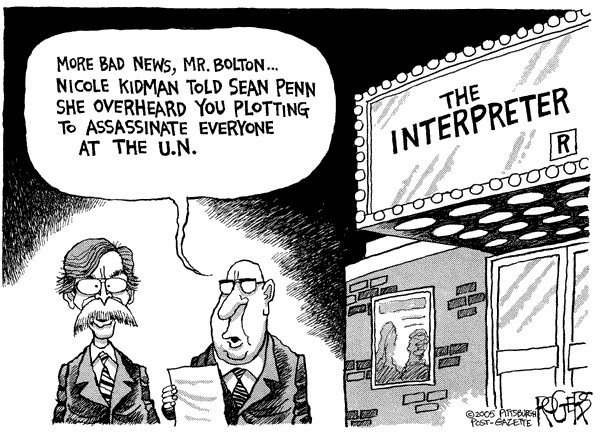
7. Bolton for U.N.--but can he sing?

8. Insurgent Bloopers

9. Superglue menace. This seems to be the only kind of ideas the Left can come up with these days.

10. An unprecedented vituperation that has entered the public discourse.

11. Don't go here. You have been warned.

12. Shawn of the Dead--where are you when we need you? (Note-although it looks authentic, this is not a real BBC URL)

13. I'm sure this kind of mistake happens a lot.

14. Why you can't trust the mainstream media. You've got to wonder what their problem is.

15. Admit it. You always wanted to be able to do this, didn't you?

Problem Fixed!

I think all the technical problems are now fixed! I asked Jeremy at American Warmonger to help me redo my template design. Everything is now in one sidebar on the left, giving more room for the posts. The site should load faster now, too.

Technical Problems

My site appears to be having some technical problems! I will try to sort them out today.

First Planet Seen Outside Solar System

This is exciting:

New images taken of an object five times the mass of Jupiter confirm that it is a giant planet closely orbiting a distant star, an international team of astronomers reported. The team of European and American astronomers said this is the first time a planet outside of our solar system has been directly observed a claim other scientists have also made.

The team first spotted the object last year as a faint reddish speck of light circling a dim brown dwarf or failed star 225 light-years away from Earth near the constellation Hydra. At the time, scientists guessed the faint light was a planet, but said further observation was needed.

The discovery touched off a debate over whether the object was actually a planet or a background star. Since the mid-1990s, scientists have discovered more than 130 of these so-called extrasolar planets by indirect means, but observing them directly has proved difficult.

Refined images taken earlier this year by the Very Large Telescope in northern Chile show two separate objects bound by gravity moving together according to Gael Chauvin, an astronomer at the European Southern Observatory, who led the team.

"Our new images show convincingly that this really is a planet, the first planet that has ever been imaged outside of our solar system," Chauvin said in a statement.

Added Benjamin Zuckerman, an astronomer at the University of California, Los Angeles, who was part of the team: "I'm more than 99 percent confident."

Chauvin's team estimated the mass of the object, called 2M1207b, by measuring its brightness. They found that it was five times the mass of Jupiter and orbited a brown dwarf, known as 2M1207A, at a distance nearly twice as far as Neptune is from the sun.

Their observations will be published in a future issue of Astronomy and Astrophysics, the scientists said.

Lynne Hillenbrand, an assistant professor of astronomy at the California Institute of Technology, said the findings were intriguing, but cautioned against calling the object a planet.


WOW! We've known that there is likely a planet around Barnard's Star, but this one is the first one ever imaged. I'm ready. Let's go!

Saturday, April 30, 2005

Bernard Lewis on Islamic Concepts of Freedom and Justice

Bernard Lewis has an absolutely fascinating essay up at Real Clear Politics/Commentary: Freedom and Justice in the Modern Middle East.


The second stage of political upheaval in the Middle East can be dated with precision. In 1940, the government of France surrendered to Nazi Germany. A new collaborationist government was formed and established in a watering place called Vichy, and General Charles de Gaulle moved to London and set up a Free French committee. The French empire was beyond the reach of the Germans at that point, and the governors of the French colonies and dependencies were free to decide: they could stay with Vichy or rally to de Gaulle. Vichy was the choice of most of them, and in particular the rulers of the French-mandated territory of Syria-Lebanon, in the heart of the Arab East. This meant that Syria-Lebanon was wide open to the Nazis, who moved in and made it the main base of their propaganda and activity in the Arab world.

It was at that time that the ideological foundations of what later became the Baath Party were laid, with the adaptation of Nazi ideas and methods to the Middle Eastern situation. The nascent party's ideology emphasized pan-Arabism, nationalism, and a form of socialism. The party was not officially founded until April 1947, but memoirs of the time and other sources show that the Nazi interlude is where it began. From Syria, the Germans and the proto-Baathists also set up a pro-Nazi regime in Iraq, led by the famous, and notorious, Rashid Ali al-Gailani.

The Rashid Ali regime in Iraq was overthrown by the British after a brief military campaign in May-June 1941. Rashid Ali went to Berlin, where he spent the rest of the war as Hitler's guest with his friend the mufti of Jerusalem, Haj Amin al-Husseini. British and Free French forces then moved into Syria, transferring it to Gaullist control. In the years that followed the end of World War II, the British and the French departed, and after a brief interval the Soviets moved in.

The leaders of the Baath Party easily switched from the Nazi model to the communist model, needing only minor adjustments. This was a party not in the Western sense of an organization built to win elections and votes. It was a party in the Nazi and Communist sense, part of the government apparatus particularly concerned with indoctrination, surveillance, and repression. The Baath Party in Syria and the separate Baath Party in Iraq continued to function along these lines.

Since 1940 and again after the arrival of the Soviets, the Middle East has basically imported European models of rule: fascist, Nazi, and communist. But to speak of dictatorship as being the immemorial way of doing things in that part of the world is simply untrue. It shows ignorance of the Arab past, contempt for the Arab present, and unconcern for the Arab future. The type of regime that was maintained by Saddam Hussein--and that continues to be maintained by some other rulers in the Muslim world--is modern, indeed recent, and very alien to the foundations of Islamic civilization. There are older rules and traditions on which the peoples of the Middle East can build.


Just go and read all of it for a several hundred year perspective on Middle Eastern Islamic society.

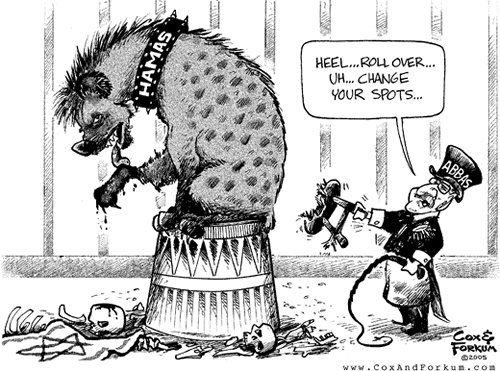
Cirque du PA

In light of this; the cartoon below seems about right.


From Cox and Forkum Posted by Hello

Mind-Boggling Abundance

From The Belmont Club:

While professional journalists may be tempted to poke fun at these early efforts the quantity of these observer-provided stories is likely to grow and its quality likely to improve. The sheer volume of information that will become available is going to make the world both more and less opaque. More opaque because the relatively simple plot lines provided by the mainstream media will be replaced by a flood of filings telling literally all sides of story. Whereas one used to be able to "understand the world" by reading the New York Times lead and grooving into the standard world view, no such simple, consolidated tales will be served up by the oncoming news avalanche. There will be no suggestive lead, no magisterial peroration, no drastic simplification. Instead there will be detail in mind-boggling abundance. The good news is that the world will become more transparent to anyone with the tools and services needed to sift through that deluge of information. The existence of so much collateral information will make it very difficult to lie on any scale. It will be possible to "know" something about an event in detail inconceivable a decade ago. There will never again be a new Walter Duranty who can foist a fraud on a reading public for any length of time from the vantage of privileged access. In short, the world threatens to become a news reader's nightmare and an intelligence analyst's paradise.


Since I stopped reading newspapers (except for what they post online), I have definitely been impressed with the "mind-boggling abundance" of information. My quest for information began after 9/11 when I began to feel that my usual sources were somehow lacking. I couldn't really put my finger on what had been bothering me about the information I was reading, but it definitely came to a head after 9/11.

Most of my adult life I have been a newsaholic--subscribing to multiple newspapers (usually a local paper, a big city paper, and the NY Times). I would read Time, Newsweek and U.S. News & World Report; I would watch CNN and Headline News every evening.

Yet, with all that reading, somewhere about the turn of the century, I began to notice they were all saying the same thing--and it always seems negative and/or hostile--especially toward the Republican Administration in the White House. I realized that in all those varied news sources, I was getting only one, uniform perspective. Then I started noticing that the front pages of my newspapers were running opinion pieces disguised as news pieces. I remember calling up the local editor of the Ann Arbor News, who told me, "Well, everybody does it now--even the New York Times."

Then, one day, while I was on the internet checking my email on AOL, I decided to look at several news stories there. Within no time, I was clicking on some original sources for news stories I was reading. Then a friend suggested that if I wanted some variety, I should check out Instapundit and tune into Fox News.

I discovered blogs.

A whole new world opened up to me and, as Wretchard so eloquently put it, "the mainstream media [was] replaced by a flood of filings telling literally all sides of story."

I have found this situation not at all a nightmare; although it is rather time consuming. One of the side-effects for me has been an increase in my focus on certain things, as I adjusted my priorities. Where before I might read every little story in the newspaper, now I tend to focus on getting as much information as possible on a specific subject that interests me. For example, I hardly ever read anything on gay marriage. I just don't care much anymore one way or the other. Sometimes something will catch my eye on the subject, but for the most part, it has become very low on my list of priorities.

I read everything from every perspective, however, on Iraq, Afghanistan, Islamic fundamentalism and the War on Terror. I am also very well-infomed about issues related to freedom of speech on campus; and North Korea. The wealth of information available on all these subjects is indeed, mind-boggling. Lies and distortions are exposed daily. What politicians said in the past comes back to haunt them regularly. And everybody had a different opinion or a different take on things. You can decide for yourself who are the fools and who are the wise.

And finally [perhaps even most importantly!] anyone can join the fray. From a world where news and information used to be held by a few elites, now we get live-blogging from the sources of news stories. Now we get opinions from many instead of from a few. I started with Instapundit, and now I read maybe 50 -100 blogs a day; read news stories from hundreds of different sources; and read op-eds from maybe 20 different newspapers.

Personally, I find the new media wonderfully exciting and endlessly fascinating. To have so much knowledge and information at one's fingertips is not just an intelligence analyst's dream--it is the ultimate dream for a compulsive news junkie.

So much information, so little time!

Friday, April 29, 2005

The Horrible Injustices Suffered By Redheads....

I'm a day behind on this, but it's too good to pass up! From James Likeks: (hat tip: Betsy's Page)

First, consider "The Interpreter." It's a big-budget suspense thriller, a movie that examines that august body of international concord, the United Nations, and how it deals with a terrorist threat. In real life, the answer would be "lunch." But since the film contains large portions of Sean Penn, one of the more cringe-inducing intellectual exhibitionists of the thespian profession, you know you're in for it.

The movie's terrorists blow up a bus in New York City. Their origin? The fictional African nation of Matobo. The producers didn't even have the nerve to use a faux Central Asian province, like Inventistan. No, they go to that hotbed of global insecurity, Matobo.

"We didn't want to encumber the film in politics in any way," Kevin Misher, the producer, told The Wall Street Journal.

Perhaps he means this: For some, the very act of mentioning Islamist terrorism is a political act, since it plays into the Bushitler/RoveCo Hate Axis scheme to shove McDonald's hamburgers down everyone's falafel hole. We can make movies about brave soldiers fighting Islamist extremists when Hillary's in power -- until then, ixnay on the Uslimsmay.

Hence this strange silence. It's like making a movie at the height of the civil rights era about the horrible injustices suffered by redheads. Originally, the terrorists of "The Interpreter" were from the Middle East. Likewise the terrorists who set off a nuclear bomb in "The Sum of All Fears"; they were changed to neo-Nazis. It's a miracle the 2001 film "Pearl Harbor" didn't show Hawaii attacked by militia members outraged over Waco.


How true.

The Ivory Tower Needs More Like This Guy

I really like Professor Adams' agenda (here's a peek, but read the whole thing):

The university is also stealing your money by charging you $175 for parking every year and not providing you all with a parking space. Currently, there are four students for every parking space. Pardon my language, but that really sucks. Expect to immediately receive a 75% reduction in your parking fees. Next, I will build a parking deck on campus. When I am finished, you will be able to park there for free.

The new parking deck will be in the place of the Cultural Arts Center, which is currently being built on the edge of campus. Let's face it, that center will probably be filled with sculptures of vaginas and African Warlords within a year. Since, no one cares about that artsy-fartsy crap, I plan to tear it down even before it is even finished.

Remember that administrators just fund these diversity projects to pad their vitae in order to get the next administrative job that pays more money. And, let's face the facts: No other school is going to hire me after I 'm done with this place
Adams is the author of Welcome to the Ivory Tower of Babel: Confessions of a Conservative College Professor. This is a fascinating book that I enjoyed thoroughly (especially coming as I do from the academic environment). It is a collection of essays on the campus culture wars. Anything that is "politically correct" is grist for Adams' mill.

The Council Has Spoken !

Image hosted by Photobucket.com
This week's winners in the Watcher's Council are now posted at the Watcher's site. Every week the Council nominates posts from the blogs of the Council members, and posts from around the blogsphere. The Council then votes to select the "Best" of all these posts.

BEST COUNCIL POSTS:

1. Silence of the Sheep Gates of Vienna

2. China's Time Bombs: The Banking System The Glittering Eye

BEST NON-COUNCIL POSTS:

1. Los Angeles Marketed as Part of Mexico by LA Hispanic Station The Blue State Conservatives

2.The EU and the Arabs IV -- War, Oil, EAD American Future

Check out all the winners!

The Human Wrongs Commission

A potent example of everything that is wrong in the world today can be found in a single Commission of the UN: The Commission on Human Rights. Anne Bayefsky at NRO gets to the heart of the idiocy and evil that the Commission symbolizes:

The dynamic reveals a great deal about the underlying U.N. pathology. With no democratic pre-conditions for membership, the commission, like the general assembly, is a forum through which non-democracies can trump democracies. Furthermore, situating democracies in an organization where relationships with non-democracies provide leverage over other democracies divides democratic states rather than bringing them together. Though the EU relishes the role of middleman between the state sponsors of terrorism or genocide and the United States, the halfway point is not where the U.S., or its fellow democracies, ought to be.

In March, Secretary-General Kofi Annan proposed saving the credibility of the U.N.'s primary human-rights body by scrapping it and creating a human-rights council. It would be elected by a two-thirds majority of U.N. members, and "those elected to the Council should undertake to abide by the highest human rights standards." This suggestion ignores the fact that states will not relinquish geographic distribution on such a U.N. body, and the vote trading and slates of regional groups means the likes of China will simply reappear. There are no democratic and rights-respecting criteria for membership. And the inevitable relationship of the council to the General Assembly — with its full panoply of despotic regimes in the front row — spells an absence of real change.


As Bayefsky points out, this is every dictator's dream -- international validation of their regime as an equal to all free nations. Why else would thugs like Saddam and Fidel go to such great extremes to showcase their "democratic" elections (in which they get 99.999% of the vote) if not to show the world how humane and free they are and that they are just as legitimate as real democracies?

By giving every two-bit thug an international podium and equal status and voice with the freedom-loving, democratic nations, the UN has managed to turn the original concept that led to its founding topsy-turvy and become a force for evil.

On the Human Wrongs Commission the dictators' dream is the entire world's nightmare.

Thursday, April 28, 2005

Hate Speech: How to Criminalize One's Political Opponents

This is one of the best and most succinct discussions of the desire to criminalize "hate speech":

This push must be, and will be, resisted by all who care deeply about freedom of speech because, at the end of the day, "hate speech" is really a very subjective judgment that very much depends on the eye of the beholder, or, if you will, the ear of the listener. Extreme examples are easy to identify, but most liberal experts in this field neglect to point out that obscene and so-called "fighting words" that invoke extreme emotion are already not protected as speech under current Constitutional jurisprudence. That being the case, the "extra" protection afforded by "hate speech" codes really are illusory. What is really going on here is an attempt to declare beyond debate certain subjects that the Left finds offensive.

More mundane examples, however, are likely not to produce such unanimity of judgment. Is Little Green Footballs and invaluable political forum that focuses on the plans and deeds of Islamic Fascists? Or is it a racist hate-site that the government should shut down? We suspect the answer to that question very much depends on one's political views.[....]

We understand that freedom of speech is painful to liberals. We know what you're going through, having had to live through the era when you controlled the public debate and no dissenting voices to liberal orthodoxy were allowed into the hallowed halls of CBS News or the New York Times.

Hate speech codes are nothing more and nothing less than an attempt to criminalize one's political opponents and should be resisted by all who care for liberty, be they right or left.(Emphasis mine--please read the entire post at New Sisyphus!)

Amen.

Crushed Again

Ah well. Crushed again. I will be seeking therapy for my press conference elevated expectation trauma (PC-EET). Posting will resume after my cure--or in a few minutes whichever comes first.

Wishful Thinking?

OK, the rumor mill has started, all because Bush is having his first press conference in a year. I'm really hoping this particular rumor is true, and that Bush will announce it. Or, maybe he'll say that the troops really did get Zarqawi and not just his laptop? Image hosted by Photobucket.com

Wishful thinking? Yes, certainly. But I can dream, can't I? And who knows? I was going to watch anyway, but now I feel much more interested in what is going to be said....

Sinking Ship


From Cox and Forkum. Posted by Hello

According to the most recent FoxNews poll:

Overall, fully 79 percent of the public think people under age 55 should have the right to choose between keeping all of their Social Security contributions in the current system and investing a portion of their funds. That support goes up to 84 percent among respondents under age 55.

On the personal level, 53 percent say they want the choice to invest a portion of their contributions, up from 48 percent in early February — soon after President Bush spoke in his State of the Union address about offering investment accounts. Among those under age 55, almost two-thirds (64 percent) want the option to invest.

More generally, when Social Security is not mentioned, most Americans say they trust themselves (77 percent) over the government (15 percent) when it comes to making retirement investment decisions.


I recently requested and received a statement from Social Security (if you would like to do so, go here). I have worked all my life and since graduating from medical school have earned a very comfortable living, even when working part-time. I was mildly surprised --both positively and negatively--by my statement.

Positively because it was nice to see that all the money I have paid into this system I would get some of it back when I retire. Negatively because I am getting so little of it back despite the large amount I have contributed over the years (anywhere from 25%- 33% of my annual income each year).

I am certainly very relieved that I have had the opportunity to keep a separate private retirement account throughout my professional life. Let me be very upfront: I am absolutely lousy with money. Ask my husband. Ask anyone in my family.

I have done all the wrong things that investment people caution against. For example, I have at various times actually cashed out some of my retirement funds for various things (e.g., when my family moved to the much more expensive Ann Arbor area from Texas a few years ago). This is a BIG no-no according to financial experts, and it wasn't the first time I did it.

All in all, I would say that I could have at this point in my life almost double what I do have in a personal retirement account-- if I had not withdrawn it for non-retirement purposes. Also over the last 5 years I have noticed a significant decrease in the amount of return on my various mutual fund investments, but have been too lazy to do anything about it. In summary then, I represent the worse possible case of indifference, idiocy, and ignorance related to investing in the market.

And yet, the interest on the amount of money I have saved in that personal account will give me more than double what Social Security will every month.

Like most reasonable people, it is hard for me to see this as a bad thing.

A Mind Is A Terrible Thing To Waste

Over at Beautiful Atrocities, an in-depth analysis of the Air America juggernaut, as it tries to take over the radio world--one Leftist mind at a time. Hilarious, and very perceptive.

P.S. You might listen to Air America once to understand how loathsome it is, but for your mental health, I wouldn't recommend it more than that. A mind is a terrible thing to waste!

The Paranoid Style

LGF is worried about the media's obsession with Abu Ghraib and wonders if this is obsessive compulsive disorder and whether it is time for an intervention.

Well, the diagnosis is incorrect. This is not Obsessive Compulsive Disorder, although there is an element of obsession about it. Think of it this way. Abu Ghraib symbolizes to the true anti-American paranoid everything they believe about America, American values and morality, and American evil. They are obsessed with Abu Ghraib precisely because they want it to prove that they have been correct about America all along.

One of the hallmarks of the paranoid, and paranoia in general, is the ability to fixate (or obsess) on one particular point to the exclusion of all other reality and to select that point as the "evidence" of their predetermined delusion.

The paranoid is actually quite perceptive--rigidly so; and they focus their attention only on those details that give support and credence to their beliefs.

David Shapiro, in his book "Neurotic Styles" comments on the Paranoid style:

In the paranoid person, even more sharply and severely than the obsessive compulsive, every aspect and component of normal autonomous functioning appears in rigid, distorted, and, in general hypertrophied form....[The]paranoid person's attention is so purposefully and narrowly directed as to amount, not merely to rigidity, but to a fixed bias.


Normal people are able to see things in context and their judgement is therefore more reliable and unbiased. The paranoid's pre-existing bias distorts his judgement and makes him unable to place facts or events in any appropriate context.

Note also all the conspiracy theories and deeply held conviction that the abuses exposed at Abu Ghraib are part of a massive government and military plot to deliberately commit atrocites and that the plot goes up the military heirarchy to the Secretary of Defense and through the Department of Defense to the White House itself. Of course, this belief pre-dates Abu Ghraib, but firmly became attached to that place when it was perceived that what happened there could be used to prop up the belief system.

So, we should not confuse this incredible paranoia concerning the behavior of a few misanthropes and sadists at Abu Ghraib, with the relatively milder preoccupations of an obsessive compulsive.

The treatment? Such people cannot be talked or reasoned out of their delusional preoccupations, because they are too central to their identity. Sometimes medication can help, but since they don't believe they have a problem, getting them to try it is usually a waste of time. There is very little insight and even less motivation to change, since reality would be too threatening.

Prognosis: Poor.

Wednesday, April 27, 2005

At Risk

Wretchard at the Belmont Club has a great series of posts up about Iran and the nuclear threat it poses to the U.S. and the world (here, here, and here). The last post emphasizes the poor intelligence the U.S. had prior to the Iraq war and our dependence on--of all things--German intelligence that was known by the Germans to be inadequate (they just didn't bother to mention it at the time); and points out that our information about Iran must be better for us to be able to act effectively there:

Command post at a hotel. Waiting for clearance to use a source that had never been directly seen. And nobody told me. Leaving aside the possibility that Mr. Tenet was set up by an allied intelligence service, nothing illustrates the poverty of the CIA's human intel than this reliance on a German controlled source to which the CIA did not have direct access yet used for one of its most critical assessments. The cupboard was bare. Given that level of failure, a certain amount of "indirect" confrontation with Iran is probably necessary to fill out an intelligence picture that is probably full of blanks before attempting anything further.

He who knows the enemy, knows self will never be at risk;
Does not know the enemy, knows self will win some and lose some;
Knows neither the enemy nor self will always be at risk.

-- Sun Tzu


Very worth reading all three posts.

What A Concept !

Believe me, this kind of thing really irks me, too. It gives Psychiatry and Psychiatrists a bad name. It seems that more and more "therapy" offered to the public by so-called "professionals" simply has as its goal the creation of a new subclass of victims.

Once you create the new subclass (e.g., women abused by their female bosses; upset parents whose kids are out of control; students who get bad grades (oh, the trauma!) by mean teachers; political parties that lose an election; Albino farmers with sensitive skin) you can milk it for all it is worth, to gain sympathy and understanding from all--and, of course, some sort of recompense for your suffering. Victimhood Rules! You are not alone! Your suffering was CAUSED by SOMEONE or SOMETHING! YOU ARE NOT TO BLAME! IT'S SOMEONE ELSE'S FAULT.

The key point [and probably the main attraction] to such victimhood therapeutics is that YOU don't have t change. It's not YOUR fault! Blame is carefully placed on external factors and the goal is to find a way to make those external factors change! Taking a pill. Or, passing a law is always a good idea, if you can get a large number of people to buy into your victimhood. Even better if you can file a lawsuit! Then you can be a rich victim.

I hear it over and over again. It's. Not. My. Fault! I will accept that they feel that way and even empathize. I even believe that there are physiological correlates in many cases. But part of my job is to help them to see that often (not always--but often) they actually have quite a bit of control over what happens to them in the world. That they have made some CHOICES that have led to the situation they are in. Now they are in a position to make some NEW CHOICES--if they really want to change things.

There are a lot of people who are truly at the mercy of forces outside their control. Children, for example. People caught up in natural disasters or accidents. Those who have severe biological vulnerabilities. But even in those cases, people can make some different choices.

The unhappy reality is that most members of the victimhood clubs only feel that they cannot control events. Typically, they can make important changes in their life that would alter their circumstances, but for various reasons have chosen not to.

It is a poor therapist indeed, who, having empathized with the feelings of helplessness on the part of their patient--never helps them to take responsibility for their behaviors. This is one of the problems with "pop" psychology. Besides oversimplifying the underlying psychological theories and rendering them rather meaningless; they often stop at the "feeling" stage (it is OK to have these feelings) and neglect the next--and equally, if not more important phase of therapy (YOU are responsible for your own life. YOU are the one who must take steps to change things).

People generally don't have much control about what they feel--emotions are fundamental physiology. BUT THEY DO HAVE CONTROL OVER HOW THEY BEHAVE. This is called Personal Responsibility.

I urge you to read this post on RESPONSIBILITY from ShrinkWrapped.

As I have pointed out to patients on many occasions: When you do not know why you behave the way you do, or feel the way you feel, you can not change anything. It is only once you understand why you are feeling the way you feel and why you do the things you do, that you have the choice of changing the behavior that causes you, and others, grief. In brief, the goal of psychoanalysis is to enlarge the area of mental life, feelings and behavior, that a person can take conscious responsibility for.


ShrinkWrapped is speaking as a psychoanalyst (a special type of psychotherapist), but all psychotherapy has a similar goal. Psychoanalysis works to change the deeper character structures and hence behavior. It is very intense and often goes on for a long period of time. But even psychoanalysis doesn't always work. One professor I remember during training, who was himself a psychoanalyst used to say, "Sometimes when you take a schmuck and analyze him, all you'll get is a well-analyzed schmuck."

Remember that old joke? How many psychiatrists does it take to change a lightbulb? Just one. But the lightbulb really has to want to change. Like all good humor, it hints at a fundamental truth that isn't ofen acknowledged.

Psychotherapy is a two-way street. No matter how brilliant the therapist, the person in therapy basically has to want to change.

All effective psychotherapy has the goal of changing behavior. And works by helping people --who want to change and take control of their lives --learn to take responsibility for their thoughts, feelings and behaviors.

What a concept.

The Neverending Temper Tantrum

John Podhoretz is quite accurate about the current mental state of the Democrats:

IN 1955, William F. Buckley Jr. famously declared that the purpose of conservatism was "to stand athwart history, yelling 'Stop,' at a time when no one is inclined to do so, or to have much patience with those who so urge it."
That astoundingly witty remark was a rueful acknowledgement of the uphill challenge facing the nascent American right, half a century ago — trying to halt the forward movement of a self-confident liberal left that was utterly certain it could make the world a better place through government action and forced social change.

Who could have imagined, reading Buckley's words in 1955, that 50 years later the liberal left would have adopted Buckley's screaming "Stop" as its mantra? Only there's nothing whimsically philosophical about the Democratic "Stop," as there was in Buckley's case. Rather, there's something primal about it, something desperate, something heartbroken and enraged.

Judges appointed by a twice-elected president who received the greatest number of votes in American history? STOP!

Find new sources of domestic oil to combat our dependence on Middle East petroleum? STOP!

A nominee for U.N. ambassador who has been confirmed four times previously by the Senate and whose views clearly dovetail with the president who nominated him? STOP!

And on and on it goes. How else to explain the wild enthusiasm, indeed the almost romantic praise, expressed by Democrats and their cheerleaders in the media for the Senate filibuster — a legislative maneuver created by a quirk in Senate rules that was most famously used to block civil-rights laws in the 1940s and 1950s?


There is something altogether childish about the continuous chorus of "No! No! No!" emanating from the minority party. Barbara Boxer and Teddy Kennedy have the whiny, petulant, foot-stomping of the spoiled brat down perfectly.

Sort of like a neverending temper tantrum.

Tuesday, April 26, 2005

Was I Prescient, Or What?

Here is a post from March 18, in which I highlighted the Galveston County retirement program. Today President Bush was in Galveston (in Levy Hall at the University of Texas Medical Branch, where I was an Assistant Dean and on the faculty of Psychiatry) to talk about their rather unique and successful program.

No matter what Barbara Boxer or Harry Reid say (and I heard them say a lot about the "failure" of this plan)--it has brought a return of THREE TIMES what the individuals who opted for it would have received from social security. Check it out at the link above.

And here's a piece by John Tierney which discusses the successful retirement plan in Chile, of all places.

After comparing our relative payments to our pension systems (since salaries are higher in America, I had contributed more), we extrapolated what would have happened if I'd put my money into Pablo's mutual fund instead of the Social Security trust fund. We came up with three projections for my old age, each one offering a pension that, like Social Security's, would be indexed to compensate for inflation:

(1) Retire in 10 years, at age 62, with an annual pension of $55,000. That would be more than triple the $18,000 I can expect from Social Security at that age.

(2) Retire at age 65 with an annual pension of $70,000. That would be almost triple the $25,000 pension promised by Social Security starting a year later, at age 66.

(3)Retire at age 65 with an annual pension of $53,000 and a one-time cash payment of $223,000.

You may suspect that Pablo has prospered only because he's a sophisticated investor, but he simply put his money into one of the most popular mutual funds. He has more money in it than most Chileans because his salary is above average, but lower-paid workers who contributed to that fund for the same period of time would be in relatively good shape, too, because their projected pension would amount to more than 90 percent of their salaries.

By contrast, Social Security replaces less than 60 percent of your salary - and that's only if you were a low-income worker. Typical recipients get back less than half of their salaries.


Someone send an alert to Paul Krugman, who as usual, is without a clue.

More Than Real Evidence Ever Could....


The next allegation against Bolton? I wouldn't be at all surprised. Posted by Hello

Meanwhile, LGF has some interesting information on one of the accusers and some of the other absurd claims.

This whole Bolton brouhaha reminds me of an episode of the Simpsons ," Bad Man", where Homer is accused of sexual harassment and suffers a trial by media as everyone seems jump on the bandwagon of saying what a bad man he is. A media circus then ensues with coverage of Homer's depravity on every channel. In particular, there is a daytime-television talk show, with the theme "mothers and runaway daughters reunited by their hatred of Homer Simpson."

One woman is sobbing and says, "I don't know Homer Simpson, I -- I never met Homer Simpson or had any contact with him, but -- [cries uncontrollably] -- I'm sorry, I can't go on." The interviewer responds, " That's OK: your tears say more than real evidence ever could."

Yeah. That about sums it up.