Showing posts sorted by relevance for query NARCISSISM. Sort by date Show all posts

Thursday, April 27, 2006

NARCISSISM AND SOCIETY

Because I'm stuck in a conference all day, I though I would recycle what I consideer to be one of my best posts on Narcissism. This is Part I in a Three-part series. Links to the other two parts are below.

[Part II is here; and Part III is here.]

For some years now, I have been thinking of way to reconcile my observations on human nature and psychology with my understanding of economic and political systems. Since I first studied it back in the 70's and 80's, I have thought that one particular psychological theory--Kohut's Psychology of the Self (as presented in his books and writings, particularly The Analysis of the Self and The Restoration of the Self )-- has some important implications for understanding why certain political systems are successful and compatible with human nature and why some are grossly incompatible with it.

So at the beginning of this essay I will make the following disclaimer: the basic ideas discussed about the Psychology of the Self belong to Heinz Kohut; and the political applications of his theories and concepts are my own thoughts. Don't blame Kohut for any errors or misstatements!

I also apologize in advance for the use of some esoteric psychiatric language. In general, I have mostly tried to explain the ideas as simply as possible (believe it or not!). My hope is that it can generate some discussion and debate.

What is Narcissism ?
I think we should start at the beginning. The term "narcissism" was coined by Sigmund Freud, who named the phenomenon after the Narcissus in Greek mythology. Narcissus was a handsome young man who rejected the desperate advances of the nymph Echo who loved him. As a punishment, the gods doomed him to fall in love with his own reflection in a pool of water. Unable to consummate his love, Narcissus pined away and changed into the flower that bears his name. (Incidentally, Echo also wasted away until she was just a whisper, barely heard).

The clinical syndrome of Narcissism (Narcissistic Personality Disorder) is described in The Diagnostic and Statistical Manual of Mental Disorders - Fourth Edition (DSM-IV) of the American Psychiatric Association as: "A pervasive pattern of grandiosity (in fantasy or behavior), need for admiration, and lack of empathy."

According to the DSM-IV, the disorder begins by early adulthood and is indicated by the subject exhibiting at least five of the following:
1. An exaggerated sense of self-importance
2. Preoccupation with fantasies of unlimited success, power, brilliance, beauty, or
ideal love
3. Believes he is "special" and can only be understood by, or should associate with, other special or high-status people (or institutions)
4. Requires excessive admiration
5. Has a sense of entitlement
6. Selfishly takes advantage of others to achieve his own ends
7. Lacks empathy
8. Is often envious of others or believes that others are envious of him
9. Shows arrogant, haughty, patronizing, or contemptuous behaviors or attitudes

Everyone has some Narcissistic traits, and a certain amount of Narcissism is a necessary and healthy thing. What’s different about the personality disorder is that the symptoms are prominent and persistent over time and pervade every aspect of the person’s existence. It can be very disabling in extreme cases; and in others those who have this personality can make the people around them thoroughly miserable, since some narcissists can be manipulative, predatory and completely lacking in empathy. Narcissists are notoriously spiteful and vicious and usually alienate anyone close to them.

Why is Narcissism Important?

All over the world, on a daily basis we see the horrible results of Narcissistic behavior. Individuals and groups; religions and nations act out their Narcissistic rage at various insults--real and imagined-- and people suffer and die for the purpose of the grandiosity of the tyrant, or the glory of the religion. It has been said that the 20th century was the “century of the Narcissist”, but the 21st is well on its way to outdoing the horrors of the past as a seeming epidemic of malignant Narcissism caused by a crushing of human nature and the human spirit--all for the purpose of serving the self-aggrandizing vision of the few.

Tim Hall of the NY Press writes:

Narcissism is hot. In the wake of the dot-com implosion and recent business scandals, many are focusing their attention on what otherwise might have remained an obscure psychological disorder. Much of the New Economy bubble seems to have arisen from narcissism run amok: The grandiosity of crooked executives and their haughty contempt for business and accounting procedures; the relentless manipulation of (and by) investors, analysts, and employees; the utter lack of empathy for others; the complete and total denial of any wrongdoing when everything fell apart.
For many on the Left side of the political spectrum, it is axiomatic that Narcissism is inextricably linked to business, Capitalism, individualism, and the pursuit of profit. The Left has idealized certain social and political systems because they suppressed the individual and elevated the state, insisting that individuals had no right to exist for their own selves, but only to serve others.

Executives, such as The Rigases of Adelphia Corp; Samuel D. Waksal, the socialite founder of ImClone Systems; Dennis Kozlowski, of Tyco International; Scott D. Sullivan of WorldCom; and Ken Lay of Enron, typify the ugly Narcissist of the business world with his or her extreme grandiosity; selfishness of unbelievable proportions; and complete lack of empathy towards the people they cheated. While the majority of businessmen are ethical and honest individuals, only a few “bad apples” are needed to demonstrate the havoc that malignant Narcissism in the business sector can wreak.

But what is not generally or readily seen (either on the Left or Right) is the flip side of "selfish" or "grandiose" Narcissism-- and that is what I will call Narcissism rooted in idealism, rather than selfishness, or "idealistic" Narcissism. This second kind of Narcissism (the flip side of the coin, if you will) is less obvious to an observer, since it is disguised with a veneer of concern for others. But it is equally—if not more—destructive and causative of human suffering, death and misery. Both kinds of Narcissism are a plague on the world; and both are well-traveled avenues for limiting freedom and imposing tyranny. The "grandiose" Narcissism is the stimulus for individual tyrants, while the "idealistic" Narcissism leads to groups imposing their will on others. We will talk more of this in Part II.

First, I need to explain what healthy Narcissism is and how it develops. The political and economic implications follow after the foundation is set.

Healthy Narcissism and Kohut’s Psychology of the Self

This part of my discussion is based on the theories of Self Psychology by Heinz Kohut. Kohut was a psychoanalyst (he died in 1981) whose controversial theories had a considerable impact on psychiatry and psychoanalysis. He was an innovative thinker (and a rather opaque writer) who broke with Freud in some important areas. His ideas have influenced me tremendously, both in the way I approach patients and understand their concerns, as well as the way I treat them. Every day in my psychiatric practice I see the truth of his ideas in the interactions I have with my patients; and in the interactions of my patients in society-at-large.

Freud’s view of Narcissism can be summed up by saying that true psychic health requires a complete dissociation from the primary Narcissism inherent in the infant and child. The individual during his or her development tries to find and maintain a form of self love that is compatible with healthy relationships with other(this is called “object relations” in psychiatry).

The bottom line is that Freud considered Narcissism quite negatively. He saw it as only associated with severe pathology and considered it the antithesis of being able to achieve normal and healthy relationships.

Some have referred to Kohut’s Psychology of the Self as "psychoanalysis without original sin"—i.e., the “original sin” that Freud considered Narcissism. One of Kohut’s breaks with Freudian tradition is that he considered Narcissism affirmatively, as an essential part of the Self; and described how it develops in the healthy individual.

What is the “Self”? The “Self” can be thought of as a content of the mental apparatus; a structure within the mind that has continuity in time and a specific location. The “Self” is therefore analogous to how one represents other people within the mind. Some people mistake the “Self” with Freud’s concept of “Ego”, but “Ego” (along with “Id” and “Superego”) are agencies of the mind, rather than a specific content of it. “Identity” can be thought of as the Self’s socio-cultural position in the world.

A healthy Self has two fundamental and equally important parts:

1) Self-Esteem – or a sense that one has a right to Life and success; ambition; a healthy exhibitionism and comfort with one’s body. This part of the Self supplies the instinctual fuel for ambition and purpose; and for enjoyment of Life’s activities.

2) Ideals – a belief in something outside the “Self” that guides and gives meaning to one’s Life. Having ideals make developing one’s goals in Life possible. It is this part of the Self that also makes healthy interpersonal relationships possible.

The development of BOTH parts is essential to psychological health. When one part develops at the expense of the other—it has grave consequences for the individual and society.

The Diagram below summarizes the normal development of the Self; and as you can see, there are two equally important and parallel lines of development that have their origin in human biology and dependence of the infant on an adult for survival during the first years of life.
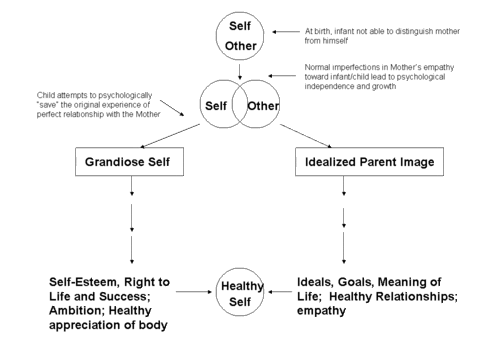
Image hosted by Photobucket.com

The infant is born with what is called “Primary Narcissism”. Mothers know that the newborn child is not able to differentiate between the Mother (referred to as “Other”) and himself (referred to as “Self”). For example, the Mother's breast is treated by the infant initially as a part of himself. Slowly over months and years, the child begins to differentiate himself from the Mother; and as he goes through normal biological development he becomes more and more independent and self-sufficient.

At some point, the Self and the Other--once "perfectly" merged--are now two distinct objects. This important process of separation-individuation is facilitated by the normal shortcomings(i.e. imperfections) in maternal care, which spur the child's development as an individual. For example: baby demands food, but mother is unavailable right now and doesn’t feed baby until her schedule permits (but doesn’t let him starve either!). Such natural and normal imperfections of empathy with the child are actually healthy. I won’t go into a full discussion of this, but suffice it to say that the Other must not be too perfect, nor too imperfect, as either extreme carried on for too long will interfere with the developing Self of the child.

It is because of the slow separation of Self from Other that the two developmental lines come into being. The first line Kohut refers to as the “Grandiose Self”(or idealized self image) and the second is referred to as the “Idealized Parent Image”. Both of these images represent psychological attempts to save the original experience of "perfection" by the infant when the Mother (Other) and the infant (Self) were “one”.

The “Grandiose Self” will develop over time (if not disrupted) into healthy Self-Esteem; and the” Idealized Parent Image” will eventually lead to the development of Ideals that give meaning to the individual’s life; and to healthy interpersonal relationships.

In Part II, I will discuss how-- when either or both of these two developmental lines are disrupted during the child's development (either through biology or environment)--they can seriously impact the individual, his/her family and even the wider society. It is my contention that these two developmental lines suggest a powerful reason why individuals may be attracted to one type of political system or another, and I will also discuss the implications of that.

Monday, April 11, 2005

NARCISSISM AND SOCIETY: Part I - The Psychology of the Self

[Part II is here; and Part III is here.]

For some years now, I have been thinking of way to reconcile my observations on human nature and psychology with my understanding of economic and political systems. Since I first studied it back in the 70's and 80's, I have thought that one particular psychological theory--Kohut's Psychology of the Self (as presented in his books and writings, particularly The Analysis of the Self and The Restoration of the Self )-- has some important implications for understanding why certain political systems are successful and compatible with human nature and why some are grossly incompatible with it.

So at the beginning of this essay I will make the following disclaimer: the basic ideas discussed about the Psychology of the Self belong to Heinz Kohut; and the political applications of his theories and concepts are my own thoughts. Don't blame Kohut for any errors or misstatements!

I also apologize in advance for the use of some esoteric psychiatric language. In general, I have mostly tried to explain the ideas as simply as possible (believe it or not!). My hope is that it can generate some discussion and debate.

What is Narcissism ?
I think we should start at the beginning. The term "narcissism" was coined by Sigmund Freud, who named the phenomenon after the Narcissus in Greek mythology. Narcissus was a handsome young man who rejected the desperate advances of the nymph Echo who loved him. As a punishment, the gods doomed him to fall in love with his own reflection in a pool of water. Unable to consummate his love, Narcissus pined away and changed into the flower that bears his name. (Incidentally, Echo also wasted away until she was just a whisper, barely heard).

The clinical syndrome of Narcissism (Narcissistic Personality Disorder) is described in The Diagnostic and Statistical Manual of Mental Disorders - Fourth Edition (DSM-IV) of the American Psychiatric Association as: "A pervasive pattern of grandiosity (in fantasy or behavior), need for admiration, and lack of empathy."

According to the DSM-IV, the disorder begins by early adulthood and is indicated by the subject exhibiting at least five of the following:
1. An exaggerated sense of self-importance
2. Preoccupation with fantasies of unlimited success, power, brilliance, beauty, or
ideal love
3. Believes he is "special" and can only be understood by, or should associate with, other special or high-status people (or institutions)
4. Requires excessive admiration
5. Has a sense of entitlement
6. Selfishly takes advantage of others to achieve his own ends
7. Lacks empathy
8. Is often envious of others or believes that others are envious of him
9. Shows arrogant, haughty, patronizing, or contemptuous behaviors or attitudes

Everyone has some Narcissistic traits, and a certain amount of Narcissism is a necessary and healthy thing. What’s different about the personality disorder is that the symptoms are prominent and persistent over time and pervade every aspect of the person’s existence. It can be very disabling in extreme cases; and in others those who have this personality can make the people around them thoroughly miserable, since some narcissists can be manipulative, predatory and completely lacking in empathy. Narcissists are notoriously spiteful and vicious and usually alienate anyone close to them.

Why is Narcissism Important?

All over the world, on a daily basis we see the horrible results of Narcissistic behavior. Individuals and groups; religions and nations act out their Narcissistic rage at various insults--real and imagined-- and people suffer and die for the purpose of the grandiosity of the tyrant, or the glory of the religion. It has been said that the 20th century was the “century of the Narcissist”, but the 21st is well on its way to outdoing the horrors of the past as a seeming epidemic of malignant Narcissism caused by a crushing of human nature and the human spirit--all for the purpose of serving the self-aggrandizing vision of the few.

Tim Hall of the NY Press writes:

Narcissism is hot. In the wake of the dot-com implosion and recent business scandals, many are focusing their attention on what otherwise might have remained an obscure psychological disorder. Much of the New Economy bubble seems to have arisen from narcissism run amok: The grandiosity of crooked executives and their haughty contempt for business and accounting procedures; the relentless manipulation of (and by) investors, analysts, and employees; the utter lack of empathy for others; the complete and total denial of any wrongdoing when everything fell apart.
For many on the Left side of the political spectrum, it is axiomatic that Narcissism is inextricably linked to business, Capitalism, individualism, and the pursuit of profit. The Left has idealized certain social and political systems because they suppressed the individual and elevated the state, insisting that individuals had no right to exist for their own selves, but only to serve others.

Executives, such as The Rigases of Adelphia Corp; Samuel D. Waksal, the socialite founder of ImClone Systems; Dennis Kozlowski, of Tyco International; Scott D. Sullivan of WorldCom; and Ken Lay of Enron, typify the ugly Narcissist of the business world with his or her extreme grandiosity; selfishness of unbelievable proportions; and complete lack of empathy towards the people they cheated. While the majority of businessmen are ethical and honest individuals, only a few “bad apples” are needed to demonstrate the havoc that malignant Narcissism in the business sector can wreak.

But what is not generally or readily seen (either on the Left or Right) is the flip side of "selfish" or "grandiose" Narcissism-- and that is what I will call Narcissism rooted in idealism, rather than selfishness, or "idealistic" Narcissism. This second kind of Narcissism (the flip side of the coin, if you will) is less obvious to an observer, since it is disguised with a veneer of concern for others. But it is equally—if not more—destructive and causative of human suffering, death and misery. Both kinds of Narcissism are a plague on the world; and both are well-traveled avenues for limiting freedom and imposing tyranny. The "grandiose" Narcissism is the stimulus for individual tyrants, while the "idealistic" Narcissism leads to groups imposing their will on others. We will talk more of this in Part II.

First, I need to explain what healthy Narcissism is and how it develops. The political and economic implications follow after the foundation is set.

Healthy Narcissism and Kohut’s Psychology of the Self

This part of my discussion is based on the theories of Self Psychology by Heinz Kohut. Kohut was a psychoanalyst (he died in 1981) whose controversial theories had a considerable impact on psychiatry and psychoanalysis. He was an innovative thinker (and a rather opaque writer) who broke with Freud in some important areas. His ideas have influenced me tremendously, both in the way I approach patients and understand their concerns, as well as the way I treat them. Every day in my psychiatric practice I see the truth of his ideas in the interactions I have with my patients; and in the interactions of my patients in society-at-large.

Freud’s view of Narcissism can be summed up by saying that true psychic health requires a complete dissociation from the primary Narcissism inherent in the infant and child. The individual during his or her development tries to find and maintain a form of self love that is compatible with healthy relationships with other(this is called “object relations” in psychiatry).

The bottom line is that Freud considered Narcissism quite negatively. He saw it as only associated with severe pathology and considered it the antithesis of being able to achieve normal and healthy relationships.

Some have referred to Kohut’s Psychology of the Self as "psychoanalysis without original sin"—i.e., the “original sin” that Freud considered Narcissism. One of Kohut’s breaks with Freudian tradition is that he considered Narcissism affirmatively, as an essential part of the Self; and described how it develops in the healthy individual.

What is the “Self”? The “Self” can be thought of as a content of the mental apparatus; a structure within the mind that has continuity in time and a specific location. The “Self” is therefore analogous to how one represents other people within the mind. Some people mistake the “Self” with Freud’s concept of “Ego”, but “Ego” (along with “Id” and “Superego”) are agencies of the mind, rather than a specific content of it. “Identity” can be thought of as the Self’s socio-cultural position in the world.

A healthy Self has two fundamental and equally important parts:

1) Self-Esteem – or a sense that one has a right to Life and success; ambition; a healthy exhibitionism and comfort with one’s body. This part of the Self supplies the instinctual fuel for ambition and purpose; and for enjoyment of Life’s activities.

2) Ideals – a belief in something outside the “Self” that guides and gives meaning to one’s Life. Having ideals make developing one’s goals in Life possible. It is this part of the Self that also makes healthy interpersonal relationships possible.

The development of BOTH parts is essential to psychological health. When one part develops at the expense of the other—it has grave consequences for the individual and society.

The Diagram below summarizes the normal development of the Self; and as you can see, there are two equally important and parallel lines of development that have their origin in human biology and dependence of the infant on an adult for survival during the first years of life.

Image hosted by Photobucket.com

The infant is born with what is called “Primary Narcissism”. Mothers know that the newborn child is not able to differentiate between the Mother (referred to as “Other”) and himself (referred to as “Self”). For example, the Mother's breast is treated by the infant initially as a part of himself. Slowly over months and years, the child begins to differentiate himself from the Mother; and as he goes through normal biological development he becomes more and more independent and self-sufficient.

At some point, the Self and the Other--once "perfectly" merged--are now two distinct objects. This important process of separation-individuation is facilitated by the normal shortcomings(i.e. imperfections) in maternal care, which spur the child's development as an individual. For example: baby demands food, but mother is unavailable right now and doesn’t feed baby until her schedule permits (but doesn’t let him starve either!). Such natural and normal imperfections of empathy with the child are actually healthy. I won’t go into a full discussion of this, but suffice it to say that the Other must not be too perfect, nor too imperfect, as either extreme carried on for too long will interfere with the developing Self of the child.

It is because of the slow separation of Self from Other that the two developmental lines come into being. The first line Kohut refers to as the “Grandiose Self”(or idealized self image) and the second is referred to as the “Idealized Parent Image”. Both of these images represent psychological attempts to save the original experience of "perfection" by the infant when the Mother (Other) and the infant (Self) were “one”.

The “Grandiose Self” will develop over time (if not disrupted) into healthy Self-Esteem; and the” Idealized Parent Image” will eventually lead to the development of Ideals that give meaning to the individual’s life; and to healthy interpersonal relationships.

In Part II, I will discuss how-- when either or both of these two developmental lines are disrupted during the child's development (either through biology or environment)--they can seriously impact the individual, his/her family and even the wider society. It is my contention that these two developmental lines suggest a powerful reason why individuals may be attracted to one type of political system or another, and I will also discuss the implications of that.
Monday, February 08, 2010

I'll DO IT YOUR WAY

I found this article in the Sunday paper extremely interesting and somewhat bizarre:
Sinatra song has fueled karaoke killings in Philippines

GENERAL SANTOS, Philippines – After a day of barbering, Rodolfo Gregorio went to his neighborhood karaoke bar still smelling of talcum powder. Putting aside his glass of Red Horse Extra Strong beer, he grasped a microphone with a habituĂ©'s self-assuredness and briefly stilled the room with the Platters' "My Prayer."

Next, he belted out crowd-pleasers by Tom Jones and Engelbert Humperdinck. But Gregorio, 63, a witness to countless fistfights and occasional stabbings from disputes over karaoke singing, did not dare choose one beloved classic: Frank Sinatra's version of "My Way."

"I used to like 'My Way,' but after all the trouble, I stopped singing it," he said. "You can get killed."

The authorities do not know exactly how many people have been killed warbling "My Way" in karaoke bars over the years in the Philippines, or how many fatal fights it has fueled. But the news media have recorded at least half a dozen victims in the past decade and include them in a subcategory of crime dubbed the "My Way Killings."

The murders have spawned urban legends about the song and have left Filipinos groping for answers. Are the killings the byproduct of a culture of violence, drinking and machismo? Or is there something inherently sinister in the song?

Whatever the reason, many karaoke bars have removed the song from their playbooks. And the country's many Sinatra lovers practice self-censorship.


The article goes on to further to suggest another potential motive for the killings: that the victims sang the song out of tune.

That makes three wildly different motives: (1) the Philippino "culture of violence"; (2)something inherently "sinister" in the song; or (3) the singer sang out of tune and angered the crowd.

(1) and (3) I could go for, since human nature is what it is. But the second motive mentioned in the article got me thinking about why I have loved this song since the first time I heard it sung by Sinatra when I was just a tyke; and why I still belt it out loudly (and off-key) in the shower at times when I'm feeling particularly good about life. Sinatra himself gives a clue. In this recording of the song, he jokes to the crowd that he's singing "...The National Anthem...but you needn't rise."


I rather like his explanation that this is the "National Anthem"; though, of course, I don't know whether Sinatra used the term because the song became more popular than he ever imagined; or because he sensed that the song somehow distilled into its lyrics the essence of the American character and spirit.

I would like to think he said it primarily because of the latter reason, since I believe that if the American spirt had an "anthem," this song would do very well.

Some of the reasons why this is so are explained in a post where I discussed the political and societal implications of narcissism.

Contrary to popular belief, every healthy individual needs to have some degree of narcissism . The word has received such a bad rap, you might believe that any degree of narcissism is a bad thing; but without a healthy dollop of it in our characters, we humans would be extremely low on ambition and purpose; and wholly unable to enjoy the pleasures of life. Believe it or not, that self-centered grandiosity that is so charming in children, is absolutely essential for normal adult self-esteem (and I don't mean the kind of faux self-esteem that is foisted on our children today). And, further, narcissism is also an essential aspect of the ideals we pursue as adults. Healthy narcissism fosters a belief in something outside of one's own self that guides and gives meaning to one’s life. This side of narcissism makes healthy interpersonal relationships possible.

But either aspect of narcissism may be defective and lead to serious problems--both for the individual and for the society.

In some ways, the rise of human civilization from the cave to the present day has resulted because of attempts through the Rule of Law and social controls to set limits on the unrestrained grandiose side of narcissism. This is primarily due to the destructiveness of the malignant narcissistic rage which is generally associated with defects in that aspect of narcissism.

Because of this, the grandiose aspects of narcissism (and those who possess them) have generally received a bad reputation philosophically, morally, and politically. The natural development of Governments and Religions (which ultimately are an expression of the the other aspect of narcissism--"idealized" narcissism--have all too often attempted to ruthlessly suppress the grandiose self--much to the detriment of the individual AND the success of the particular society or religion.

In fact, despite the obvious truth that governments, nations, and religions are in a much better position to wreak far more systemized misery and death on human populations, it is almost always the grandiose narcissism that gets the blame. But a quick glance at the last several hundred years will demonstrate that all those idealistic "people's revolutions" supported by the political Left (grand champions of idealized narcissism) and purportedly for the purpose of "freeing" large populations of people have somehow mysteriously resulted instead in enslaving those populations and increasing authoritarian rule.

Without a political or economic framework that is able to incorporate what we refer to as "human nature" into its calculations, all so-called "perfect" societies and ideologies will at best simply fail in the real world; and at worse cause untold human suffering. With the best of intentions (this is perhaps debatable), the social engineers of philosophy, political science, and economics have caused so much more slavery, misery and death on a grand scale--that the grandiose CEO's of the largest corporations can be considered mere pikers by comparison.

When we talk about the individual versus society; or the individual versus the state; or indeed any discussion of individual rights versus the rights of a group, we are also referring to the psychological tension between the two poles of the Self. Any political or economic system that expects to succeed in the real world will have to accommodate that tension, and find a way to optimally negotiate the needs of BOTH sides of the Self--that is, they will have to take into account human nature.

A perusal of any list of economic systems will demonstrate that ALMOST ALL OF THEM are relatively extreme expressions of idealized narcissism. Almost all emphasize the group, the community, the collective, the nation, the state, or god at the expense of the individual. Examples are numerous. Socialism and Communism; fascism and religious fundamentalism.

The major exception is capitalism, where the individual and the individual's needs are emphasized over the the group.

What is essential for healthy individuals, as well as for healthy societies is that there be a balance of these two aspects of narcissism--the grandiose and the idealized. Because an over emphasis on one results in a culture or society promoting sociopathy; and an overemphais on the other results in submission and slavery to the collective.

So the sentiments in "My Way" are nothing more than a healthy expression of the grandiose self; which is why America stands as a shining beacon if freedom and libery in a world where the norm is to oppress such expressions of individuality and promote submission to the group. "I'll Do It Your Way" would be the appropriate anthem for those societies.

For what is a man? What has he got?
If not himself, then he has naught
To say the things he truly feels,
And not the words of one who kneels...
The record shows I took the blows
And did it my way
!

UPDATE: After writing this morning, I went over to Belmont Club where I discovered that Wretchard had penned a few words on the subject of the "My Way" killings....

Wednesday, February 28, 2007

NARCISSISM AND THE SELF-ESTEEM GURUS

Is this study really come as a surprise to anyone?

Today's college students are more narcissistic and self-centered than their predecessors, according to a comprehensive new study by five psychologists who worry that the trend could be harmful to personal relationships and American society.

"We need to stop endlessly repeating 'You're special' and having children repeat that back," said the study's lead author, Professor Jean Twenge of San Diego State University. "Kids are self-centered enough already."
[...]
The researchers describe their study as the largest ever of its type and say students' NPI scores have risen steadily since the current test was introduced in 1982. By 2006, they said, two-thirds of the students had above-average scores, 30 percent more than in 1982.

Narcissism can have benefits, said study co-author W. Keith Campbell of the University of Georgia, suggesting it could be useful in meeting new people "or auditioning on 'American Idol.'"

"Unfortunately, narcissism can also have very negative consequences for society, including the breakdown of close relationships with others," he said. The study asserts that narcissists "are more likely to have romantic relationships that are short-lived, at risk for infidelity, lack emotional warmth, and to exhibit game-playing, dishonesty, and over-controlling and violent behaviors."

Twenge, the author of "Generation Me: Why Today's Young Americans Are More Confident, Assertive, Entitled and More Miserable Than Ever Before," said narcissists tend to lack empathy, react aggressively to criticism and favor self-promotion over helping others.

If you want to understand the pros and cons of narcissism, I refer you to this series of posts.

Amazing, isn't it? Thinking you're hot stuff isn't the cure-all promised by the self-esteem gurus. Most psychiatrists could tell you this. Here are some findings from an earlier analysis of multiple studies on self-esteem:
A generation — and many millions of dollars — later, it turns out we may have been mistaken. Five years ago, the American Psychological Society commissioned me and several other experts to wade with an open mind through the enormous amount of published research on the subject and to assess the benefits of high self-esteem.

Here are some of our disappointing findings. High self- esteem in schoolchildren does not produce better grades. (Actually, kids with high self-esteem do have slightly better grades in most studies, but that's because getting good grades leads to higher self-esteem, not the other way around.) In fact, according to a study by Donald Forsyth at Virginia Commonwealth University, college students with mediocre grades who got regular self-esteem strokes from their professors ended up doing worse on final exams than students who were told to suck it up and try harder.Self-esteem doesn't make adults perform better at their jobs either. Sure, people with high self-esteem rate their own performance better — even declaring themselves smarter and more attractive than their low self-esteem peers — but neither objective tests nor impartial raters can detect any difference in the quality of work.

Likewise, people with high self-esteem think they make better impressions, have stronger friendships and have better romantic lives than other people, but the data don't support their self-flattering views. If anything, people who love themselves too much sometimes annoy other people by their defensive or know-it-all attitudes. Self-esteem doesn't predict who will make a good leader, and some work (including that of psychologist Robert Hogan writing in the Harvard Business Review) has found humility rather than self-esteem to be a key trait of successful leaders.

It was widely believed that low self-esteem could be a cause of violence, but in reality violent individuals, groups and nations think very well of themselves. They turn violent toward others who fail to give them the inflated respect they think they deserve. Nor does high self-esteem deter people from becoming bullies, according to most of the studies that have been done; it is simply untrue that beneath the surface of every obnoxious bully is an unhappy, self-hating child in need of sympathy and praise.

High self-esteem doesn't prevent youngsters from cheating or stealing or experimenting with drugs and sex. (If anything, kids with high self-esteem may be more willing to try these things at a young age.)There were a few areas where higher self-esteem seemed to bring some benefits. For instance, people with high self- esteem are generally happier and less depressed than others, though we can't quite prove that high self-esteem prevents depression or causes happiness. Young women with high self- esteem seem less susceptible to eating disorders. In some studies (though not all), people with high self-esteem bounce back from misfortune and trauma faster than others.

High self-esteem also promotes initiative. People who have it are more likely to speak up in a group, persist in the face of failure, resist other people's advice or pressure and strike up conversations with strangers. Of course, initiative can cut both ways: One study on bullying found that self-esteem was high among the bullies and among the people who intervened to resist them. Low self-esteem marked the victims of bullying.

In short, despite the enthusiastic embrace of self-esteem, we found that it conferred only two benefits. It feels good and it supports initiative.


Most people confuse "self-esteem" with what I will refer to as a "sense of self". It is the latter--not the former, that is so often screwed up in the angry, violent, grandiose, and generally narcissistic people in the world. If you have a healthy "Self", you are likely to have a healthy self-esteem--which is not the same at all as a high self-esteem.

The psychological defect that leads to so many problems is a defective or distorted sense of one's SELF. The excessive self-esteem you see in a bully comes from a distortion of reality that person has with regard to their self. It was once widely believed that low self-esteem was a cause of violence--and you see that idea reflected today in the platitudes and rationalizations of terrorism-- but in reality violent individuals, groups and nations think very well of themselves.

Do you really suppose that people like Ahmadinejad, Nasrallah, Bin Laden or Kim suffer from poor self-esteem? On the contrary. Exaggerated self-esteem is one of the hallmarks of a pathological narcissist or psychopath.

The pop-psychology that promulgated the widespread belief that if you nurture kid's self-esteem neglected to mention that if the sense of self was already damaged, all you managed to do was to create a narcissist; and it is simply a waste of time and money--as this article reports.

If the 19th century was the age of hysteria (and basically, Freud was responding to the excessive sexual repression present in that century); then the 20th was the age of narcissism. In this new century, that narcissism seems to be morphing into an even more malignant sociopathy that pervades society and impacts almost all our social, political, and educational institutions.

Our cultural focus on enhancing "self-esteem" has resulted in the near-worship of emotions and feelings at the expense of reason and thought; on emphasizing "root causes" and victimhood, instead of demanding that behavior be civilized and that individuals exert self-discipline and self-control--no matter what they are "feeling".

For years now, pop psychology and its gurus have mesmerized the culture at large. All their self-help tenets have percolated through K-12 educational curricula; and been accepted wholeheartedly by the cultural elite of Hollywood and the intellectual elite of academia.

The triumvarate of contradictions that claims to be based on "scientific" psychology includes the hyping of (1) self-esteem (increasing your self-worth without having to achieve anything; (2) hope (achieving your goals without any real effort) and (3) victimhood (it's not your fault that you haven't achieved anything or made any effort). See here for more discussion.

Steve Salerno, writing in the LA Times tackles the third leg of this holy psychological quest --the hyping of hope in the "self-help" movement. It seems the intellectual impoverishment of all these pseudoscientific psychological deceptions are now becoming apparent:
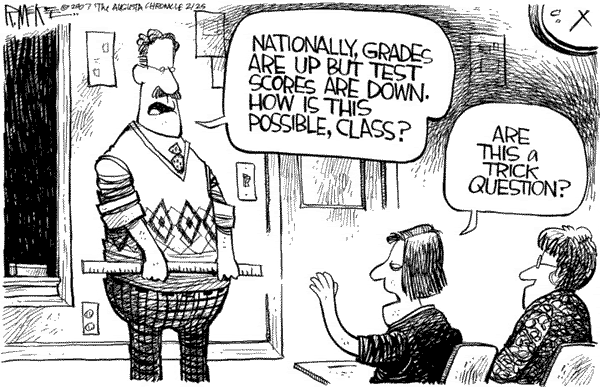
Over a 20-year span beginning in the early 1970s, the average SAT score fell by 35 points. But in that same period, the contingent of college-bound seniors who boasted an A or B average jumped from 28% to an astonishing 83%, as teachers felt increasing pressure to adopt more "supportive" grading policies. Tellingly, in a 1989 study of comparative math skills among students in eight nations, Americans ranked lowest in overall competence, Koreans highest — but when researchers asked the students how good they thought they were at math, the results were exactly opposite: Americans highest, Koreans lowest. Meanwhile, data from 1999's omnibus Third International Mathematics and Science Study, ranking 12th-graders from 23 nations, put U.S. students in 20th place, besting only South Africa, Lithuania and Cyprus.

Still, the U.S. keeps dressing its young in their emperors' new egos, passing them on to the next set of empowering curricula. If you teach at the college level, as I do, at some point you will be confronted with a student seeking redress over the grade you gave him because "I'm pre-med!" Not until such students reach med school do they encounter truly inelastic standards: a comeuppance for them but a reprieve for those who otherwise might find ourselves anesthetized beneath their second-rate scalpel.

The larger point is that society has embraced such concepts as self-esteem and confidence despite scant evidence that they facilitate positive outcomes. The work of psychologists Roy Baumeister and Martin Seligman suggests that often, high self-worth is actually a marker for negative behavior, as found in sociopaths and drug kingpins.

We see the people who have inhaled this "psychology-lite" everywhere around us, and in all levels of society. Particularly we can notice it in the elites of Hollywood and Academia; who alternate between acting out their narcissistically empowered superiority -- demanding to be noticed, admired and loved (by you); and playing the narcissistically empowered victim -- demanding their inalienable rights and priveleges (at your expense).

But the real victims of all this hype are our children, because these foolish notions, without a scintilla of scientific evidence and only becaue it makes some people feel good about themselves, have become the pop psychology dogma of public policy in education.

In Narcissism and Society I wrote:

All over the world, on a daily basis we see the horrible results of Narcissistic behavior. Individuals and groups; religions and nations act out their Narcissistic rage at various insults--real and imagined-- and people suffer and die for the purpose of the grandiosity of the tyrant, or the glory of the religion. It has been said that the 20th century was the “century of the Narcissist”, but the 21st is well on its way to outdoing the horrors of the past as a seeming epidemic of malignant Narcissism caused by a crushing of human nature and the human spirit--all for the purpose of serving the self-aggrandizing vision of the few.


For many on the left side of the political spectrum, it is axiomatic that narcissism is inextricably linked to business, capitalism, individualism, and the pursuit of profit. The political left has idealized certain social and political systems because they suppressed the individual and elevated the state, insisting that individuals had no right to exist for their own selves, but only to serve others.

Executives, such as The Rigases of Adelphia Corp; Samuel D. Waksal, the socialite founder of ImClone Systems; Dennis Kozlowski, of Tyco International; Scott D. Sullivan of WorldCom; and Ken Lay of Enron, typify the ugly narcissist of the business world with his or her extreme grandiosity; selfishness of unbelievable proportions; and complete lack of empathy towards the people they cheated. While the majority of businessmen are ethical and honest individuals, only a few “bad apples” are needed to demonstrate the havoc that malignant narcissism in the business sector can wreak.

But what is not generally or readily seen (either on the left or right) is the flip side of "selfish" or "grandiose" narcissism-- and that is what I will call narcissism rooted in idealism, rather than selfishness, or "idealistic" narcissism (discussed at some length here if you are interested). This second kind of narcissism (the flip side of the coin, if you will) is less obvious to an observer, since it is disguised with a veneer of concern for others. But it is equally—if not more—destructive and causative of human suffering, death and misery. Both kinds of narcissism are a plague on the world; and both are well-traveled avenues for limiting freedom and imposing tyranny. The "grandiose" narcissism is the stimulus for individual tyrants, while the "idealistic" Narcissism leads to groups imposing their will on others.

One such group happens to be the "Self-Esteem Gurus" in education, whose nonsense continues to reinforce the inappropriate grandiosity of young children; just as the radical environmentalists and kumbayah types (among other groups) continue to reinforce the malignant selflessness.

Between the two influences unleashed on the vulnerable minds of our children, is it any surprise that by the time they get to college, kids are either dysfunctional self-absorbed narcissists, naively malignant do-gooders, or completely and irrevocably cynical about the pervasive indoctrination and anti-intellectualism they have been subjected to in their educational careers?

As a writer in the LA Times say somewhat understatedly, "Gen Y's ego trip is likely to take a nasty turn". Yes, it is --along with the society they will inherit.

Tuesday, February 12, 2008

NARCISSISM IN THE NATIVE RAW...

...and speaking of that phenomenon as I was in the previous post; here is the ever grandiose James Wolcott opining on matters psychological (and the lefties get on MY case about making psychological pronouncements--at least I've got some training in the field) about the reason some conservatives don't like (ok, really really hate) John McCain:

And despite his CPAC speech, it's unlikely that McCain is going to be able to win over the dead-enders in his own party. Pop into the comments sections of some of the more conservative blogs (be sure to get your vaccination shots first though before delving into such fetid waters), and you'll find a sporadic but persistent barrage of references to "John McLame" "John McAmnesty" "John McPain" and similar Algonquin Roundtable witticisms. They're quite happy to cut off their noses to spite their faces because spite is what they live for and on. As for the rightwing talk radio tea-kettle whistles, most of them aren't going to be modulating their tone or changing their tune anytime soon. They have too much invested in their own self-righteous posturing to get with the program now. I haven't listened to much rightwing talk radio in recent years and what struck me from monitoring Sean Hannity, Mark Levin, and such on Sirius' Patriot channel is that their animosity toward McCain is topped only by their own grandiosity. The sort of hacky quacks whose psychotherapeutic blogs appear at Pajamas Media are always drivelling on about liberal Democrats being afflicted with toxic narcissism (this sort of slop), but you don't know what narcissism in the native raw until you've heard Sean Hannity and Mark Levin crow about their unwavering conservative principles and the record of ringing pronouncements they've made and will continue to make as long as the love of Ronald Wilson Reagan beats in their hearts and now we have a call from Connecticut, Mike calling from the car phone, Mike you're on the air--well, we seem to have lost Mike...

Even though Levin, classy gent that he is, refers "Hillary Rotten Clinton, Her Thighness," I wonder if he and his litter mates are going to be able to mount the hate-on against her than everyone anticipates. Yes, they hate Hillary, yawn, but they've hated her for so long that they already sound hoarse and their insults tired. As for sliming Obama, yes, I've heard the "Barry Hussein" and "Osama Obama" cracks too, but it'll be harder for them to go outright racist on him because that's truly the no-go zone in talk radio now. Just ask Don Imus, who had his cowboy hat handed to him over the "nappy ho's" slur and now sounds like warm mush whenever the conversation tilts toward skin color. He refers to Hillary as "Satan," but it sounds less like a bladed insult and more like shtick he's too lazy to update.[emphasis mine]

The "slop" that Wolcott references and which stimulated his annoyance is a post by Siggy (another professional in the field) who dares to discuss the fundamental toxic victim mentality and pathological narcissism that defines the today's left as a movement; and Wolcott makes a rather typical sort of mistake when he talks about the idea of "narcissism in the native raw".

Like many laypersons, Wolcott assume that narcissism is always a bad thing.

It isn't.

In fact, as I have pointed out repeatedly, narcissism--when there is a optimal synthesis of both the grandiose elements and the idealistic elements-- is an absolutely essential ingredient for a healthy, functional personality. For healthy narcissism, the essential task of the individual is to combine the grandiose side of the personality-- which is responsible for developing individual ambition and the energy to pursue happiness, as well as a feeling that one has a fundamental right to that life and happiness; with the idealistic side--which provides the ability to to develop values and ideals (see here for a full discussion). An excess of either side leads to dysfunctional, self-serving and often toxic behavior.

By definition, all ambitions, values and ideals are necessarily narcissistically invested. How could it be otherwise? These are the factors that define us as individuals.

The classic pathological narcissist cannot imagine anyone acting from 'unwavering' principles, because to them ideals and values only exist to service the grandiose self and can be adjusted as necessary for the whim of the moment. In other words, such 'narcissists in the raw' are developmentally stuck, and frequently flip-flop between malignant grandiosity and the idealism and values du jour that are felt to service that grandiosity.

Certainly radio personalities, as well as celebrities in general (like most politicians) have an abundance of narcissism. Whether that narcissism is of the pathological type or whether it springs from a healthy synthesis (see here and here) of the two parallel developmental tracks of narcissism can only be assessed by their behavior and the consequences of that behavior. If Wolcott really wants to understand the "drivel" we psychological professionals put out on this topic, he should consider the devastation and innumerable deaths brought about by all those wonderful leftist utopian ideologies of the 20th century. Now there was pathological narcissism in the native raw on a grand scale, the kind the political left can get behind.

At least when Sean Hannity 'cuts off his nose to spite his face' or acts out of spite, his behavior is personal and it has a limited impact. When it comes to that kind of localized behavior high honors must be shared by members of both political parties.

Nevertheless, if Sean Hannity and others want to go down with their conservative principles completely inviolate and not vote for McCain-- that is their choice. I can appreciate and even honor such a principled choice. By the same token, it is also Nancy Pelosi's choice to call Iraq a failure and insist despite all the evidence that the surge is not working.

What 'prinicple' is Pelosi adhering to with unwavering determination? Ask yourself how it benefits Sean Hannity to be correct about McCain not being a true conservative and unworthy of support; versus how it benefits Nancy Pelosi that her country admit defeat and failure at the hands of a terrorist group. In the former case, if Hannity is correct, the Republicans and even Hannity lose. In the latter scenario, America loses but Pelosi and the Democrats win big---really big.

Placing your bets on your country losing a war so that you can win an election is the gamble the entire left has wagered. Contrast Pelosi's stance with McCain's statement that he'd rather 'lose a campaign than lose a war'. Which of the two has a serious narcissistic defect going for them and sees their own needs as first and foremost?

I happen to think Hannity's decision is a bad choice because in politics the 'perfect' is often the enemy of the 'good' and because of the nature of the beast, we voters (who each struggle with their own narcissistic conflicts) are often faced with the option of only voting for the least obnoxious candidate. Yet, Hannity is capable of being convinced to support McCain (I heard him say so last night). Is Pelosi capable of supporting America in a war if a Republican is in the White House? Don't bet on it.

What's really laughable to me is that the leftist pundits can't even figure out what kind of behavioral pathology is going on here: some are moaniing about how the conservatives will "march in ideological lockstep" with party leaders no matter what; while others --like Wolcott-- insist that those same conservatives are too narcissistically invested in 'posturing' about their 'unwavering conservative principles' to vote for the likes of John McCain.

Their confusion can be understood by looking at an example of the 'unwavering principles' of the left found in this story , which shows how the feckless antiwar, antimilitary types who 'speak truth to power' and posture with grandiose flair--can only stick to their principles when it doesn't have any personal consequences for them.

And speaking of "marching in ideological lockstep"--could there be a finer example of goosestepping than the expectation that all blacks or women must be Democrats support Democrat policies--otherwise they are by definition 'traitors' to their gender or race? Isn't the whole 'identity politics' thing a mandate to conform to your group or race or tribe in order to maintain ideological purity?

In point of fact, both of these positions that are attributed to conservatives are actually psychological projections on the left's part, because they represent the only possible positions their rigid dialectical and propagandized brains can imagine. Due to the narcissistic defect that the entire movement suffers from, they are all more or less stuck on either the grandiose or the idealistic narcissistic pole without the ability to synthesize the two extremes of the dialectic. Thus they vascillate between the cold grandiosity inherent in believing they know what's best for all of us; and the utopian idealism that leads them to impose --by force if necessary--those beliefs on everyone else.

Undoubtedly some of those who hate McCain with a passion are motivated by raw narcissism--as are some of those who support him, I would imagine. But that there might be principled opposition on the part of conservatives to John McCain, well 'that sort of slop' is a concept that is beyond the likes of Wolcott and the rest of the wildly unprincipled and intellectually bankrupt political left.

Tuesday, March 17, 2009

WELCOME TO THE GOLDEN AGE OF NARCISSISM

I'm sure it's hard for the self-esteem gurus to process this kind of data:
Praising children at every opportunity is creating a generation of narcissists who cannot take criticism, according to a leading psychologist.
Dr Carol Craig warned teachers and parents that the constant drive to build self-esteem in schoolchildren had gone too far.

Addressing a head teachers' conference, Dr Craig said that adults had become too afraid to correct children's mistakes in case it upset them.

Dr Craig, chief executive of the Centre for Confidence and Wellbeing, said: 'We are wrong in thinking we have to get the "I" bigger.

'If we say to people the most important thing is how you feel about yourself, then if a child fails maths and feels bad, it is very tempting for them to blame it on others like teachers and parents. Parents no longer want to hear if their children have done anything wrong. This is the downside of the self-esteem agenda.'

Parents are increasingly challenging teachers over their child's minor failures at school, such as doing badly in a spelling test or missing out on the lead role in the school play, because they claim such knockbacks are damaging to the child's confidence.

Since September 2007, all UK schools have had a statutory responsibility to promote the wellbeing of their pupils.

But Dr Craig says the wellbeing agenda has been taken too far by both teachers and parents who are wrapping children in cotton wool and turning them into narcissists.


I'm sure you are just shocked at this analysis. "Not MY little narcissist!" you're saying to yourself, I bet.

Or, can this study really come as a surprise to anyone?
Today's college students are more narcissistic and self-centered than their predecessors, according to a comprehensive new study by five psychologists who worry that the trend could be harmful to personal relationships and American society.

"We need to stop endlessly repeating 'You're special' and having children repeat that back," said the study's lead author, Professor Jean Twenge of San Diego State University. "Kids are self-centered enough already."
[...]
The researchers describe their study as the largest ever of its type and say students' NPI scores have risen steadily since the current test was introduced in 1982. By 2006, they said, two-thirds of the students had above-average scores, 30 percent more than in 1982.

Narcissism can have benefits, said study co-author W. Keith Campbell of the University of Georgia, suggesting it could be useful in meeting new people "or auditioning on 'American Idol.'"

"Unfortunately, narcissism can also have very negative consequences for society, including the breakdown of close relationships with others," he said. The study asserts that narcissists "are more likely to have romantic relationships that are short-lived, at risk for infidelity, lack emotional warmth, and to exhibit game-playing, dishonesty, and over-controlling and violent behaviors."

Twenge, the author of "Generation Me: Why Today's Young Americans Are More Confident, Assertive, Entitled and More Miserable Than Ever Before," said narcissists tend to lack empathy, react aggressively to criticism and favor self-promotion over helping others.

If you want to understand the pros and cons of narcissism, I refer you to this series of posts.

Amazing, isn't it? Thinking you're hot stuff isn't the cure-all promised by the self-esteem gurus. Most psychiatrists would be able to tell you this--except that many of them have also been fed the "you're soooooo special" kool-aid diet, too. But, here are some findings from an earlier analysis of multiple studies on self-esteem:
A generation — and many millions of dollars — later, it turns out we may have been mistaken. Five years ago, the American Psychological Society commissioned me and several other experts to wade with an open mind through the enormous amount of published research on the subject and to assess the benefits of high self-esteem.

Here are some of our disappointing findings. High self- esteem in schoolchildren does not produce better grades. (Actually, kids with high self-esteem do have slightly better grades in most studies, but that's because getting good grades leads to higher self-esteem, not the other way around.) In fact, according to a study by Donald Forsyth at Virginia Commonwealth University, college students with mediocre grades who got regular self-esteem strokes from their professors ended up doing worse on final exams than students who were told to suck it up and try harder.Self-esteem doesn't make adults perform better at their jobs either. Sure, people with high self-esteem rate their own performance better — even declaring themselves smarter and more attractive than their low self-esteem peers — but neither objective tests nor impartial raters can detect any difference in the quality of work.

Likewise, people with high self-esteem think they make better impressions, have stronger friendships and have better romantic lives than other people, but the data don't support their self-flattering views. If anything, people who love themselves too much sometimes annoy other people by their defensive or know-it-all attitudes. Self-esteem doesn't predict who will make a good leader, and some work (including that of psychologist Robert Hogan writing in the Harvard Business Review) has found humility rather than self-esteem to be a key trait of successful leaders.

It was widely believed that low self-esteem could be a cause of violence, but in reality violent individuals, groups and nations think very well of themselves. They turn violent toward others who fail to give them the inflated respect they think they deserve. Nor does high self-esteem deter people from becoming bullies, according to most of the studies that have been done; it is simply untrue that beneath the surface of every obnoxious bully is an unhappy, self-hating child in need of sympathy and praise.

High self-esteem doesn't prevent youngsters from cheating or stealing or experimenting with drugs and sex. (If anything, kids with high self-esteem may be more willing to try these things at a young age.)There were a few areas where higher self-esteem seemed to bring some benefits. For instance, people with high self- esteem are generally happier and less depressed than others, though we can't quite prove that high self-esteem prevents depression or causes happiness. Young women with high self- esteem seem less susceptible to eating disorders. In some studies (though not all), people with high self-esteem bounce back from misfortune and trauma faster than others.

High self-esteem also promotes initiative. People who have it are more likely to speak up in a group, persist in the face of failure, resist other people's advice or pressure and strike up conversations with strangers. Of course, initiative can cut both ways: One study on bullying found that self-esteem was high among the bullies and among the people who intervened to resist them. Low self-esteem marked the victims of bullying.

In short, despite the enthusiastic embrace of self-esteem, we found that it conferred only two benefits. It feels good and it supports initiative.


Most people confuse "self-esteem" with what I will refer to as a "sense of self". It is the latter--not the former, that is so often screwed up in the angry, violent, grandiose, and generally narcissistic people in the world. If you have a healthy "Self", you are likely to have a healthy self-esteem--which is not the same at all as a high self-esteem.

The psychological defect that leads to so many problems is a defective or distorted sense of one's SELF. The excessive self-esteem you see in a bully comes from a distortion of reality that person has with regard to their self. It was once widely believed that low self-esteem was a cause of violence--and you see that idea reflected today in the platitudes and rationalizations of terrorism-- but in reality violent individuals, groups and nations think very well of themselves.

Do you really suppose that tyrants and thugs like Ahmadinejad, Nasrallah, Bin Laden or Kim suffer from poor self-esteem? On the contrary. Exaggerated self-esteem is one of the hallmarks of a pathological narcissist or psychopath. And we are churning them out at a rapid clip in our k-12 and university system.

We're absolutely convinced that "all the children are above-average", and we intend to prove it!

The pop-psychology that promulgated the widespread belief that if you nurture kid's self-esteem neglected to mention that if the sense of self was already damaged, all you managed to do was to create a narcissist; and it is simply a waste of time and money--as all this data suggests. Are we really surprised at the number of psychopathic, antisocial and criminal and unethical Wall Street barracuda's that are out there, who think personal integrity and responsibility are for wimps and chumps? Or, are we shocked that most of the self-centered, superficial and unbelievably narcissistic morons we elect to Congress to represent us are enriching themselves at our expense, even as they virtuously declare they are only doing it for our own good;or, even more laughably, "for the children"?

If the 19th century was the age of hysteria (and basically, Freud was responding to the excessive sexual repression present in that century); then the 20th was the age of narcissism. In this new century, that narcissism seems to be morphing into an even more malignant sociopathy that pervades society and impacts almost all our social, political, and educational institutions.

Our cultural focus on enhancing "self-esteem" has resulted in the near-worship of emotions and feelings at the expense of reason and thought; on emphasizing "root causes" and victimhood, instead of demanding that behavior be civilized and that individuals exert self-discipline and self-control--no matter what they are "feeling".

For years now, pop psychology and its gurus have mesmerized the culture at large. All their self-help tenets have percolated through K-12 educational curricula; and been accepted wholeheartedly by the cultural elite of Hollywood and the intellectual elite of academia.

The triumvarate of contradictions that claims to be based on "scientific" psychology includes the hyping of (1) self-esteem (increasing your self-worth without having to achieve anything; (2) hope (achieving your goals without any real effort) and (3) victimhood (it's not your fault that you haven't achieved anything or made any effort). See here for more discussion.

Steve Salerno, writing in the LA Times tackles the third leg of this holy psychological quest --the hyping of hope in the "self-help" movement. It seems the intellectual impoverishment of all these pseudoscientific psychological deceptions are now becoming apparent:
Over a 20-year span beginning in the early 1970s, the average SAT score fell by 35 points. But in that same period, the contingent of college-bound seniors who boasted an A or B average jumped from 28% to an astonishing 83%, as teachers felt increasing pressure to adopt more "supportive" grading policies. Tellingly, in a 1989 study of comparative math skills among students in eight nations, Americans ranked lowest in overall competence, Koreans highest — but when researchers asked the students how good they thought they were at math, the results were exactly opposite: Americans highest, Koreans lowest. Meanwhile, data from 1999's omnibus Third International Mathematics and Science Study, ranking 12th-graders from 23 nations, put U.S. students in 20th place, besting only South Africa, Lithuania and Cyprus.

Still, the U.S. keeps dressing its young in their emperors' new egos, passing them on to the next set of empowering curricula. If you teach at the college level, as I do, at some point you will be confronted with a student seeking redress over the grade you gave him because "I'm pre-med!" Not until such students reach med school do they encounter truly inelastic standards: a comeuppance for them but a reprieve for those who otherwise might find ourselves anesthetized beneath their second-rate scalpel.

The larger point is that society has embraced such concepts as self-esteem and confidence despite scant evidence that they facilitate positive outcomes. The work of psychologists Roy Baumeister and Martin Seligman suggests that often, high self-worth is actually a marker for negative behavior, as found in sociopaths and drug kingpins.

We see the people who have inhaled this "psychology-lite" everywhere around us, and in all levels of society. Particularly we can notice it in the elites of Hollywood and Academia; who alternate between acting out their narcissistically empowered superiority -- demanding to be noticed, admired and loved (by you); and playing the narcissistically empowered victim -- demanding their inalienable rights and priveleges (at your expense).

But the real victims of all this hype are our children, because these foolish notions, without a scintilla of scientific evidence and only becaue it makes some people feel good about themselves, have become the pop psychology dogma of public policy in education.

In Narcissism and Society I wrote:
All over the world, on a daily basis we see the horrible results of Narcissistic behavior. Individuals and groups; religions and nations act out their Narcissistic rage at various insults--real and imagined-- and people suffer and die for the purpose of the grandiosity of the tyrant, or the glory of the religion. It has been said that the 20th century was the “century of the Narcissist”, but the 21st is well on its way to outdoing the horrors of the past as a seeming epidemic of malignant Narcissism caused by a crushing of human nature and the human spirit--all for the purpose of serving the self-aggrandizing vision of the few.


For many on the left side of the political spectrum, it is axiomatic that narcissism is inextricably linked to business, capitalism, individualism, and the pursuit of profit. The political left has idealized certain social and political systems because they suppressed the individual and elevated the state, insisting that individuals had no right to exist for their own selves, but only to serve others.

Executives and businessmen, such as Bernie Madoff; or the Rigases of Adelphia Corp; Samuel D. Waksal, the socialite founder of ImClone Systems; Dennis Kozlowski, of Tyco International; Scott D. Sullivan of WorldCom; and Ken Lay of Enron, typify the ugly narcissist of the business world with his or her extreme grandiosity; destructive selfishness of unbelievable proportions; and complete lack of empathy towards the people they cheated. While the majority of businessmen are ethical and honest individuals, only a few “bad apples” are needed to demonstrate the havoc that malignant narcissism in the business sector can wreak.

But what is not generally or readily seen (either on the left or right) is the flip side of "selfish" or "grandiose" narcissism-- and that is what I will call narcissism rooted in idealism, rather than selfishness, or "idealistic" narcissism (discussed at some length here if you are interested). This second kind of narcissism (the flip side of the coin, if you will) is less obvious to an observer, since it is disguised with a veneer of concern for others. But it is equally—if not more—destructive and causative of human suffering, decay, death and misery. Both kinds of narcissism are a plague on the world; and both are well-traveled avenues for limiting freedom and imposing tyranny. The "grandiose" narcissism is the stimulus for individual tyrants, while the "idealistic" Narcissism leads to groups imposing their will on others.

One such group happens to be the "Self-Esteem Gurus" in education, whose nonsense continues to reinforce the inappropriate grandiosity of young children; just as the radical environmentalists and kumbayah types (among other groups) continue to reinforce the malignant selflessness.

Between the two influences unleashed on the vulnerable minds of our children, is it any surprise that by the time they get to college, kids are either dysfunctional self-absorbed narcissists, naively malignant do-gooders, or completely and irrevocably cynical about the pervasive indoctrination and anti-intellectualism they have been subjected to in their educational careers?

As a writer in the LA Times say somewhat understatedly, "Gen Y's ego trip is likely to take a nasty turn". Yes, we are already seeing the consequences on a daily basis.

Welcome to the Golden Age of Narcissism! Please check common sense and reality at the door before entering....

Monday, September 28, 2009

PERSONAL RESPONSIBILITY AND THE GOLDEN AGE OF NARCISSISM

From Mark Steyn's column this week, "Dislike Obama? You Must Be Racist":
Melissa Harris-Lacewell, professor of African-American studies at Princeton, was invited on to National Public Radio to expound on the use of “racial code words” in “the current opposition to health care reform.” For example, explained professor Harris-Lacewell, “language of personal responsibility is often a code language used against poor and minority communities.”

“Personal responsibility” is racial code language? Phew, thank goodness America is belatedly joining Canada and Europe in all but abolishing the concept.

“Code language” is code language for “total bollocks.” “Code word” is a code word for “I’m inventing what you really meant to say because the actual quote doesn’t quite do the job for me.” “Small government”? Racist code words! “Non-confiscatory taxes”? Likewise. “Individual liberty”? Don’t even go there! To an incisive NPR racism analyst, the elderly gentleman telling his congressman “I’m very concerned by what I’ve heard about wait times for MRIs in Canada” is really saying “I’m unable to overcome my deep-seated racial anxieties about the sexual prowess of black males, especially now they’re giving prime-time press conferences every night.” With interpreters like professor Harris-Lacewell on the prowl, I’m confident 95 per cent of Webster’s will eventually be ruled “code language.”


For years now, pop psychology and its gurus have mesmerized the culture at large. All their self-help tenets have percolated through K-12 educational curricula; and been accepted wholeheartedly by the cultural elite of Hollywood and the intellectual elite of academia.

The triumvarate of contradictions that claims to be based on "scientific" psychology includes the hyping of (1) self-esteem (increasing your self-worth without having to achieve anything); (2) hope (achieving your goals without any real effort) and (3) victimhood (it's not your fault that you haven't achieved anything or made any effort). See here for more discussion.

These three fundamental axioms of leftist thought have risen to prominence in our society as the denigration of the concept of personal responsibility has taken hold. In fact, as you can see from Steyn's column above, the very use of the words have become politically incorrect--racist, even--primarily because personal responsibility is not compatible with the leftist definition of those three fundamental axioms.

After several decades, the intellectual impoverishment brought about by faux self-esteem, fairy-tale utopian fantasies, and eternal victimhood--all pseudoscientific psychological deceptions designed to maintain dependence on leftist ideology-- are now becoming apparent:
Over a 20-year span beginning in the early 1970s, the average SAT score fell by 35 points. But in that same period, the contingent of college-bound seniors who boasted an A or B average jumped from 28% to an astonishing 83%, as teachers felt increasing pressure to adopt more "supportive" grading policies. Tellingly, in a 1989 study of comparative math skills among students in eight nations, Americans ranked lowest in overall competence, Koreans highest — but when researchers asked the students how good they thought they were at math, the results were exactly opposite: Americans highest, Koreans lowest. Meanwhile, data from 1999's omnibus Third International Mathematics and Science Study, ranking 12th-graders from 23 nations, put U.S. students in 20th place, besting only South Africa, Lithuania and Cyprus.

Still, the U.S. keeps dressing its young in their emperors' new egos, passing them on to the next set of empowering curricula. If you teach at the college level, as I do, at some point you will be confronted with a student seeking redress over the grade you gave him because "I'm pre-med!" Not until such students reach med school do they encounter truly inelastic standards: a comeuppance for them but a reprieve for those who otherwise might find ourselves anesthetized beneath their second-rate scalpel.

The larger point is that society has embraced such concepts as self-esteem and confidence despite scant evidence that they facilitate positive outcomes. The work of psychologists Roy Baumeister and Martin Seligman suggests that often, high self-worth is actually a marker for negative behavior, as found in sociopaths and drug kingpins.


We see the people who have inhaled this "psychology-lite" everywhere around us, and in all levels of society. Particularly we can notice it in the elites of Hollywood and Academia; who alternate between acting out their narcissistically empowered superiority -- demanding to be noticed, admired and loved (by you); and playing the narcissistically empowered victim -- demanding their inalienable rights and priveleges (at your expense).

But the real victims of all this hype are our children, because these foolish notions, without a scintilla of scientific evidence and only becaue it makes some people feel good about themselves, have become the pop psychology dogma of public policy in education; and the corollary of their implementation is an equal and opposite de-emphasis on taking personal responsibility for one's actions and behaviors and accepting the consequences, both good and bad. One's character is not only determined by successes in life, but by how failures are dealt with. Self-esteem is the by-product of negotiating those successes and failures with integrity and honesty. "Hope" is meaningless unless it escapes the land of fantasy and conforms with reality; and victimhood should only be a transient state that motivates a person to change behavior--not a celebration or a way of life.

For many on the left side of the political spectrum, the concept of "personal responsibility" is inextricably linked to conservative moral principles; to business success and capitalism; and to the bugaboo of collectivists everywhere, individualism. It is no secret that the political left has idealized certain social and political systems because they suppressed the individual and elevated the state, insisting that individuals had no right to exist for their own selves, but only to serve others.

Those on the left mistakenly believe that it is individualism and "evil" capitalism that is linked to narcissistic behavior. But as I have explained in previous posts, there is a flip side to "selfish" or "grandiose" narcissism-- and that is narcissism rooted in idealism, rather than selfishness; or "idealistic" narcissism (discussed at some length here if you are interested). This second kind of narcissism (the flip side of the coin, if you will) is less obvious to an observer, since it is disguised with a veneer of concern for others. But it is equally—if not more—destructive and causative of human suffering, decay, death and misery. Both kinds of narcissism are a plague on the world; and both are well-traveled avenues for limiting freedom and imposing tyranny. The "grandiose" narcissism is the stimulus for individual tyrants, while the "idealistic" narcissism leads to groups imposing their will on others.

The idealistic narcissist is invested in utopian fantasies. Their self-esteem is derived from the power they feel in controlling the lives of others, and they desperately need to maintain a constant supply of "victims" they can pretend to champion. In general, they are extremely resistant to taking responsibility for their own behavior or the implementation of their utopian dreams--all of which have been emotionally catastrophic for the individuals in the system. Is it any wonder that the political left identifies personal responsibility as a dangerous and radical concept? In a world where personal responsibility and accountability for one's behavior is expected, they themselves would have to answer to that thing we call "reality."

This they cannot and will not do.

Hence they have constructed a whole system ("political correctness") to stigmatize and intimidate those who believe that self-esteem must be earned by achievement and is dependent on one's choices and actions; that "hope and change" come about not by wishing and lovely rhetoric, but by doing; and that your current bad situation may not be (entirely) your own fault, but by constantly externalizing blame for that situation, you miss opportunities to make necessary changes in your own behavior that keep you down. By taking responsibility for your own life, you stop waiting to be rescued and do what you have to do to rescue yourself. You can stay a "victim" and wallow in "victimhood", but the essence of maturity and adulthood is taking charge of your own life and not letting others dictate who you should be, or what you should do.

Unhealthy narcissism (yes, a certain amount of narcissism not only can be healthy, it is essential to function optimally in life) is encouraged by the "self-esteem gurus" in education, whose nonsense continues to reinforce the inappropriate grandiosity of young children by facilitating a faux self-esteem; just as the radical environmentalists and politically correct, kumbayah types (among other groups) continue to reinforce the malignant selflessness that comes from fervently believing in the perfectibility of human beings.

Between the two influences unleashed on the vulnerable minds of our children, is it any surprise that by the time they get to college, kids are either dysfunctional, self-absorbed narcissists; naively malignant do-gooders; or (at best) completely and irrevocably cynical about the pervasive indoctrination and anti-intellectualism they have been subjected to in their educational careers?

As this article from the LA Times says somewhat understatedly, "Gen Y's ego trip is likely to take a nasty turn". Yes, we are already seeing the consequences on a daily basis.

Welcome to the Golden Age of Narcissism! Please check all personal responsibility, common sense and reality at the door before entering....

Wednesday, April 22, 2009

NARCISSISM WITHOUT BOUNDS

Charles Krauthammer recently commented on Obama's response to Ortega's diatribe against the US:
The most telling moment, however, was when Daniel Ortega, the president of Nicaragua, delivered a 53-minute excoriating attack on the United States. And Obama's response was "I'm grateful that President Ortega did not blame me for the things that occurred when I was three months old."

Does the narcissism of this man know no bounds? This is not about him. It is about his country. This is something that occurred under John Kennedy — the Bay of Pigs is what he is referring to. And what he is saying is that it's OK that he attacked John Kennedy, as long as it wasn't me.

Doesn't it occur to him that he ought to defend his country even if stuff happened before him? It doesn't all start with him.


As Krauthammer knows all too well, since he is a psychiatrist, a real narcissist actually does believe everything starts with him, and that he is the center of the universe.

As far a Barack Obama is concerned, it is all about him.

L'etat, c'est moi! Soon, like Louis XIV, and every petty tyrant and political demagogue since, Obama the First will declare himself to be above the law. His massive ego will demand no less.

Meanwhile, Jay Nordlinger has a moment of fantasy:
Do you know what I wish our president had said? Something like, “Well, the Bay of Pigs was terribly executed. But it was a noble cause: the overthrow of a heinous dictatorship. One that denies an entire people their natural, God-given rights. Had that operation succeeded, Cuba would have been infinitely better off, and the world would have been better off. And many good and brave men died in that operation. If we are to be sorry for anything, it’s that the operation did not succeed, not that it occurred.”

...Can you imagine the American president yukking it up with a thug like Ortega about an ignominious moment in the American past? You don’t have to imagine. That’s the kind of president we have. The kind the people voted for, apparently. Great.


'Great' pretty much sums it up. We have a president whose narcissism already appears to know no bounds; and whose ego is fed constantly by the MSM and the left in whose eyes he is a major celebrity, i.e., a god (same thing these days). You will see them get annoyed and even impatient with their god, but truth be told, they adore him and know he will be merciful and forgive them for their disbelief--as long as he keeps throwing them fresh meat to feed their anger and resentment.

We are dealing with a bunch of narcissistic, entitled children, because that's what the political left has devolved into. I think it's important to realize from all this, that the left is scared. REALLY scared. Quoting from a psychiatrist that Byron York tapped for his column on "In Time of Victory, Why is the Left So Angry?" (an extremely good question):
I asked William Anderson, a friend who is a political conservative, a medical doctor, and a lecturer in psychiatry at Harvard. "They are angry, but I think they are also scared, and I think it's because they have a sense that their triumph is a precarious one," Anderson told me. Democrats won in 2008 in some part because of the cycles of American politics; Republicans were exhausted and it was the other party's turn. Now, having won, they are unsure of how long victory will last.

"They see that they have a very small window of opportunity to do all the things they want," Anderson continued. "They see the window of opportunity as small because they know in their deepest hearts that the vast majority of the American people wouldn't go for all of the things they want to do." So they are frantic to do as much as possible before the opposition coalesces. And the tea parties might be the beginning of that coalescence.

Then there is the question of self-image. Watching Garofalo and Olbermann discuss the tea parties, it was impossible to avoid the sense that they saw themselves as two good people talking about many bad people. "One of the things about narcissism is that it looks like people who are just proud of themselves and smug, but in fact narcissism is a very brittle and unstable state," Anderson told me. "People who are deeply invested in narcissism spend an awful lot of energy trying to maintain the illusion they have of themselves as being powerful and good, and they are exquisitely sensitive to anything that might prick that balloon."[emphasis mine]


You see, these are the two sides of of this political narcissism that defines Obama and his leftist base. The grandiosity and smugness on the one hand; and, on the other, the brittleness and anxiety that comes with maintaining a false self-image.

One of the ways the left can continue to deflect that anxiety and keep their fear at bay; AND at the same time pump up their already over-inflated egos and self-righteousness is to perpetually persecute and blame Bush Administration. The left externalized blame for their own inadequacies when they weren't in power, so it is hardly likely that they'd stop now once they are in power. They remain completely inadequate and fall quite short of even the simple tasks of leadership. That's why Obama's every other utterance has to do with blaming Bush and Republicans (who certainly share some of the real blame for the fiscal mess; and ALL of the "blame" for having kept us safe for the last 8 years. Interesting, isn't it, that it is for the latter crime that they are to be severely punished?). Also, be sure to watch closely in the coming months for the Obama administration to externalize blame on another favorite scapegoat of today's left--Israel.

Bush has to be kept in the media spotlight because the left's malignant narcissism demands to be fed. By bashing Bush they can preen and strut, stroke themselves to orgasmic heights of self-congratulatory moral superiority. The safety of their country is completely irrelevant--it's all about them.

That's why the anger and rage that the left has nurtured and cultivated over the last 8 years will not go away. They need it desperately to keep their fragile, rotting narcissistic and grandiose self image--even if they have to destroy this country to do so.

Narcissism without bounds; to infinity and beyond.